
Every term from your lessons, in plain English
Short definitions of the words you hear in Qaida, Tajweed and Hifz lessons, with the Arabic and a simple example where it helps.
 By Muhammad Areeb · Reviewed
What do Tajweed and Qaida terms mean?
Qaida terms describe how letters are read: harakat are the short vowel marks, sukoon means a letter has no vowel and shaddah doubles a letter. Tajweed terms describe how the Quran is recited correctly, such as makharij (where sounds are made), ghunnah (nasal sound) and qalqalah (a slight echo on five letters).
- Harakat
- Short vowel marks: fatha, kasra, damma
- Sukoon
- No vowel on the letter
- Shaddah
- The letter is doubled
- Ghunnah
- Nasal sound held about two counts
- Qalqalah
- Echo on ق ط ب ج د with sukoon
Qaida and reading terms
Noorani Qaida القاعدة النورانية
A step-by-step primer that teaches reading from the single letters to Quranic words. See the Noorani Qaida guide.
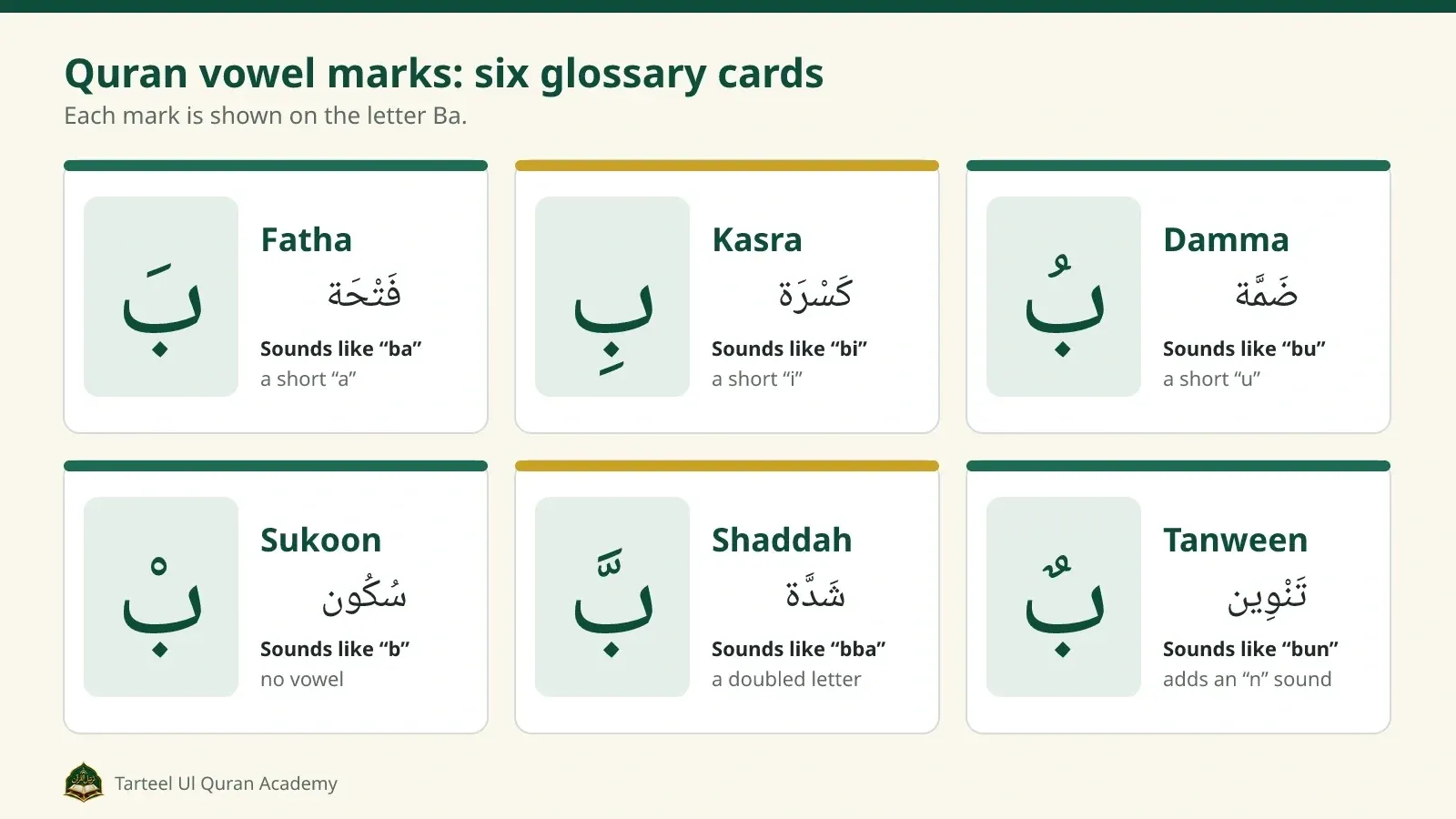
Harakat حَرَكَات
The short vowel marks written above or below a letter: fatha, kasra and damma.
Fatha فَتْحَة
A small diagonal stroke above a letter, giving a short a sound: بَ (ba).
Kasra كَسْرَة
A small diagonal stroke below a letter, giving a short i sound: بِ (bi).
Damma ضَمَّة
A small curl above a letter, giving a short u sound: بُ (bu).
Sukoon سُكُون
A small circle above a letter, meaning it has no vowel and closes the syllable before it: مِنْ is read min.
Shaddah شَدَّة
A small mark like a w above a letter, meaning the letter is doubled: read once with sukoon and once with its vowel. رَبِّ is read rab-bi.
Tanween تَنْوِين
A doubled vowel mark at the end of a word that adds an n sound: بً ban, بٍ bin, بٌ bun.
Madd letters حُرُوف المَدّ
The letters alif, waw and ya when they lengthen the vowel before them: بَا baa, بُو boo, بِي bee.
Hamzah هَمْزَة
A short catch in the throat, written ء, often sitting on an alif, waw or ya.
Joined forms
The shapes a letter takes at the start, middle or end of a word. Six letters never join to the letter after them: ا د ذ ر ز و.
Nazra ناظرہ
An Urdu term used in South Asia for reading the Quran by looking at the text, after the Qaida and before or alongside Hifz.
Tajweed terms
Tajweed تَجْوِيد
The rules for reciting the Quran correctly: each letter from its proper place, with its proper qualities. See what Tajweed is.
Makharij مَخَارِج
The points of articulation: where in the throat, tongue, lips or nose each letter is made. Singular: makhraj. See the makharij guide.
Sifat صِفَات
The qualities of a letter, such as heavy or light, that separate letters made in similar places.
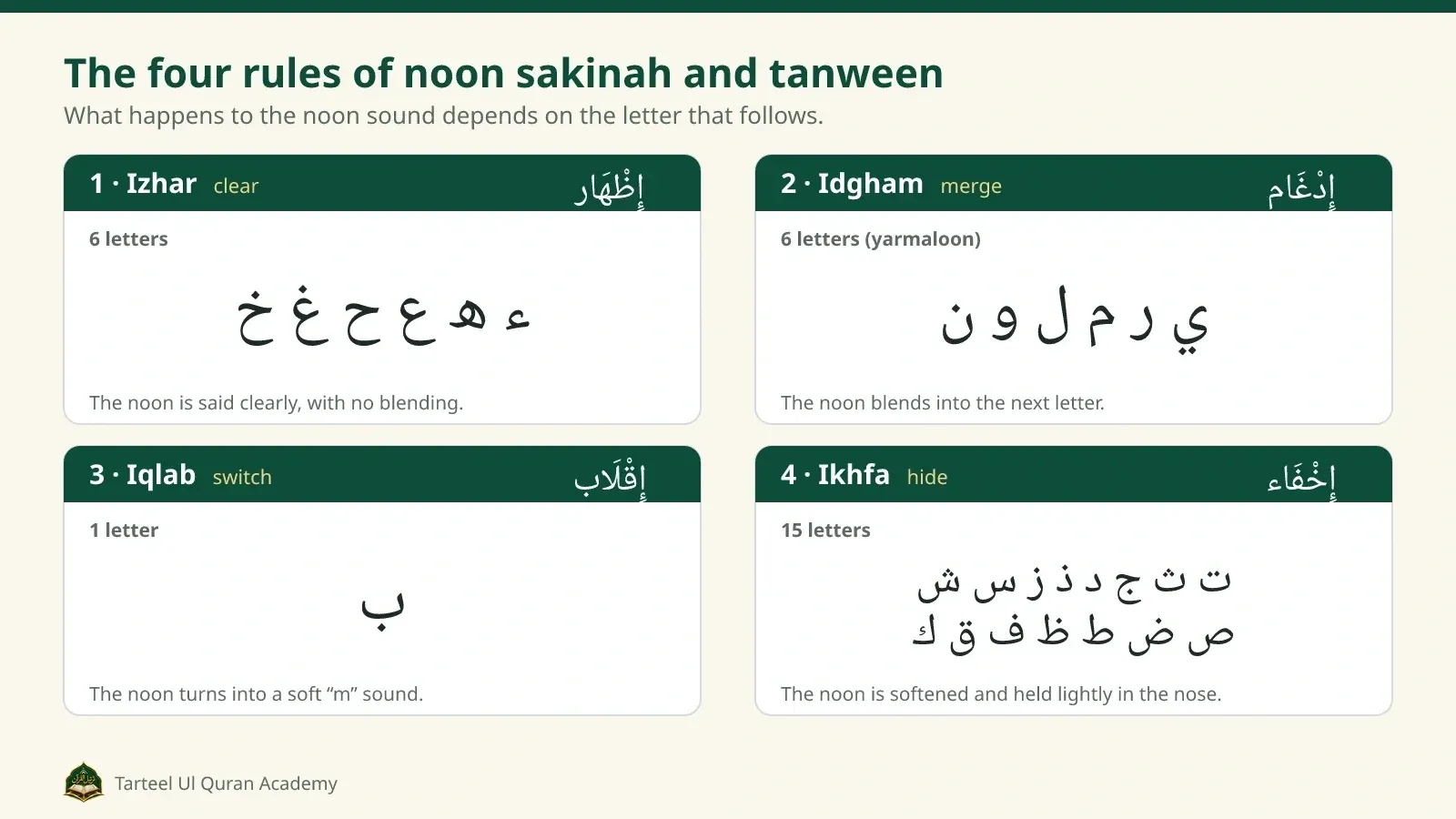
Noon sakinah نُون سَاكِنَة
A noon with sukoon. It and tanween follow four rules depending on the next letter: izhar, idgham, iqlab and ikhfa.
Izhar إِظْهَار
Pronouncing the noon clearly, without extra nasal sound, before the six throat letters ء ه ع ح غ خ.
Idgham إِدْغَام
Merging the noon into the next letter. Before ي ن م و it merges with ghunnah; before ل ر it merges without ghunnah.
Iqlab إِقْلَاب
Changing the noon to a meem sound, with ghunnah, before the letter ب.
Ikhfa إِخْفَاء
Hiding the noon with a nasal sound before the remaining fifteen letters.
Meem sakinah مِيم سَاكِنَة
A meem with sukoon. It is hidden before ب, merged into another meem, and pronounced clearly before all other letters.
Ghunnah غُنَّة
A nasal sound from the nose, held for about two counts, heard most clearly on noon and meem with shaddah.
Qalqalah قَلْقَلَة
A slight echo or bounce on the five letters ق ط ب ج د when they carry sukoon.
Madd مَدّ
Lengthening a vowel. Natural madd lasts two counts; longer madd depends on what follows, such as a hamzah or a sukoon.
Tafkhim and tarqiq تَفْخِيم وتَرْقِيق
Heavy (full-mouthed) and light pronunciation. Some letters are always heavy; ra and the lam in the name Allah can be either, by rule.
Waqf وَقْف
Stopping at the end of a word while reciting, guided by the stopping signs printed in the Mushaf.
Terms for the Quran’s structure and memorization
Mushaf مُصْحَف
A printed or written copy of the Quran.
Surah سُورَة
A chapter of the Quran. There are 114 surahs.
Ayah آيَة
A verse of the Quran.
Juz جُزْء
One of 30 roughly equal parts the Quran is divided into for reading and revision. Juz ʿAmma, the last part, holds many short surahs.
Riwayah رِوَايَة
A transmitted way of reciting the Quran. Lessons here follow Hafs ʿan ʿĀsim, the most widely used today.
Tilawah تِلَاوَة
Recitation of the Quran.
Tarteel تَرْتِيل
Reciting in a measured, unhurried way, as in Quran 73:4.
Hifz حِفْظ
Memorizing the Quran. Someone who has memorized all of it is called a hafiz (حَافِظ). See how to memorize the Quran.
Sabaq
Today’s new lines in a Hifz routine, recited from memory to the teacher.
Sabqi
Recent revision: the pages memorized over the last days or weeks, checked for accuracy.
Manzil
Long-term revision: older portions recited from memory in a cycle so they do not fade.
Sabaq, sabqi and manzil are the names used in many South Asian Hifz programmes; other teachers use different names for the same three parts.
Revise with free flashcards
Ten questions on the Arabic letters and vowel marks every beginner learns before reading the Quran.
How many letters are in the Arabic alphabet?Show the answer
28 (hamza is sometimes counted separately).
What is a fatha?Show the answer
A small diagonal stroke above a letter that gives a short “a” sound, as in بَ (ba).
What is a kasra?Show the answer
A small diagonal stroke below a letter that gives a short “i” sound, as in بِ (bi).
What is a damma?Show the answer
A small waw-shaped mark above a letter that gives a short “u” sound, as in بُ (bu).
What does a sukun show?Show the answer
That the letter has no vowel and joins the vowel before it, as in مِنْ (min).
What does a shaddah do?Show the answer
It doubles the letter, as in رَبِّ (rabbi).
Free 30-minute first lesson. No card or payment needed. Monthly plans, no long-term contract.