
Where should you start? Find out in two minutes
Your starting point depends on what you can read today, not on your age. This page helps you choose, and your free lesson confirms it.
 By Muhammad Areeb · Reviewed
Which Quran course should a beginner start with?
Start with Quran Reading (the Noorani Qaida) if you cannot yet read the Arabic letters with their vowel marks. Choose guided reading if you can read but slowly, Tajweed if you read fluently but without the rules, and Hifz only once reading and basic Tajweed are steady.
- Cannot read the letters yet
- Quran Reading (Noorani Qaida)
- Reads slowly, guesses words
- Guided reading from the Mushaf
- Reads fluently, no rules
- Tajweed
- Reads well with Tajweed
- Hifz or understanding
Try these five reading tasks in order
Work down the list and stop at the first task that feels hard. That task shows your starting point. Read everything aloud; it is fine to be slow.
- Name these letters: ب ت ث ج ح خ. If you are unsure, start with Quran Reading from the letters.
- Read these with their vowel marks: بَ بِ بُ. If the marks are unclear, start with Quran Reading at the vowel stage.
- Read these joined words: مِنْ رَبِّ. If sukoon or shaddah trips you up, start with the later Qaida stages.
- Read the first verse of Surat al-Fatihah from a Mushaf without stopping on every letter. If you can, but slowly, choose guided reading.
- Read a page with the rules applied: ghunnah, madd and stopping signs. If you read fluently but do not know these rules, choose Tajweed.
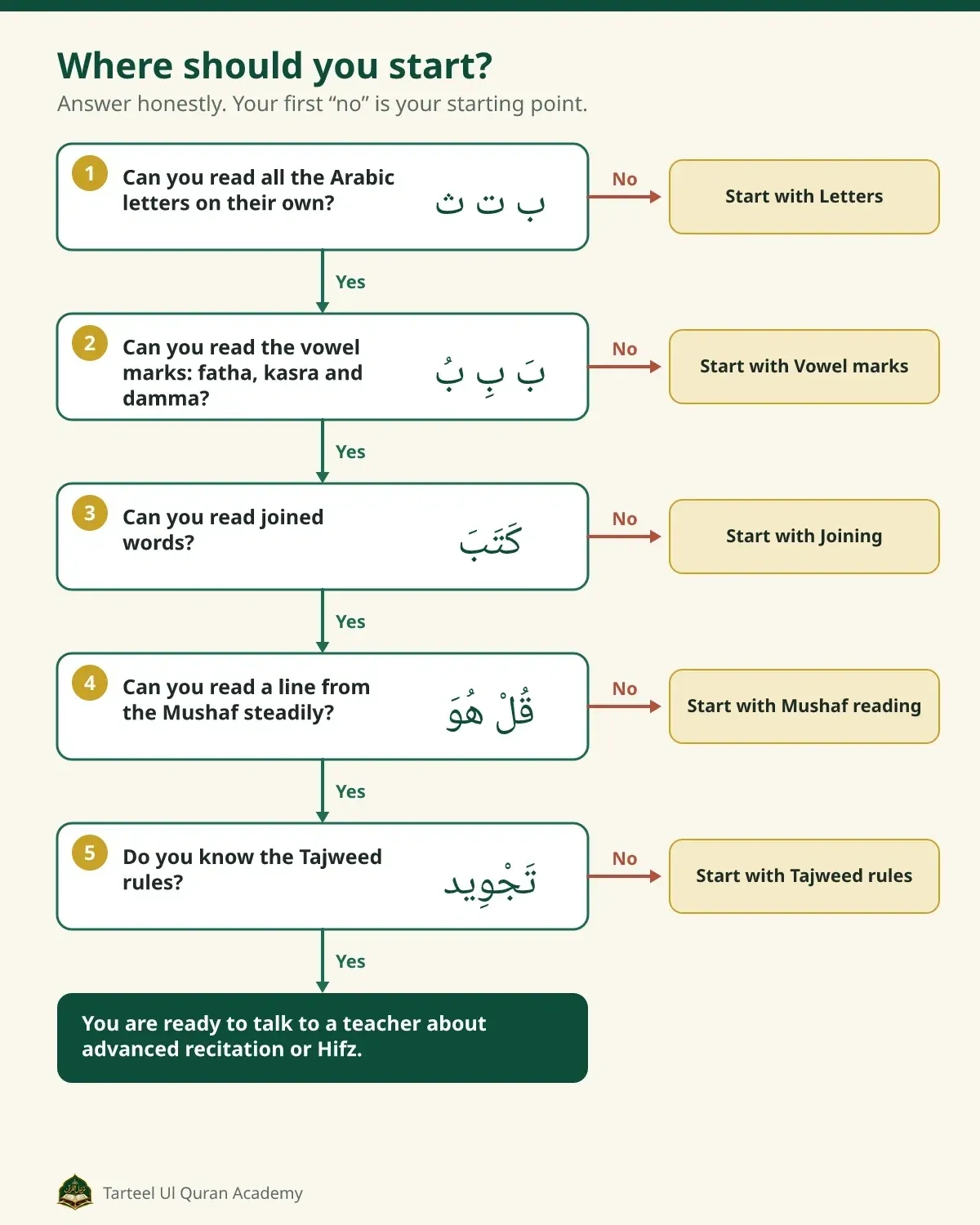
Could you do all five comfortably? You are ready for Hifz or for studying meaning with Quranic Arabic.
Or pick a course by what you want to achieve
Placing a child: Qaida, reading, Tajweed or Hifz?
Place a child by what they can read today, not by their age or school year. Two eight-year-olds can need very different starting points, and starting a little lower than expected is far better than struggling a level too high. Children can start from age 4.
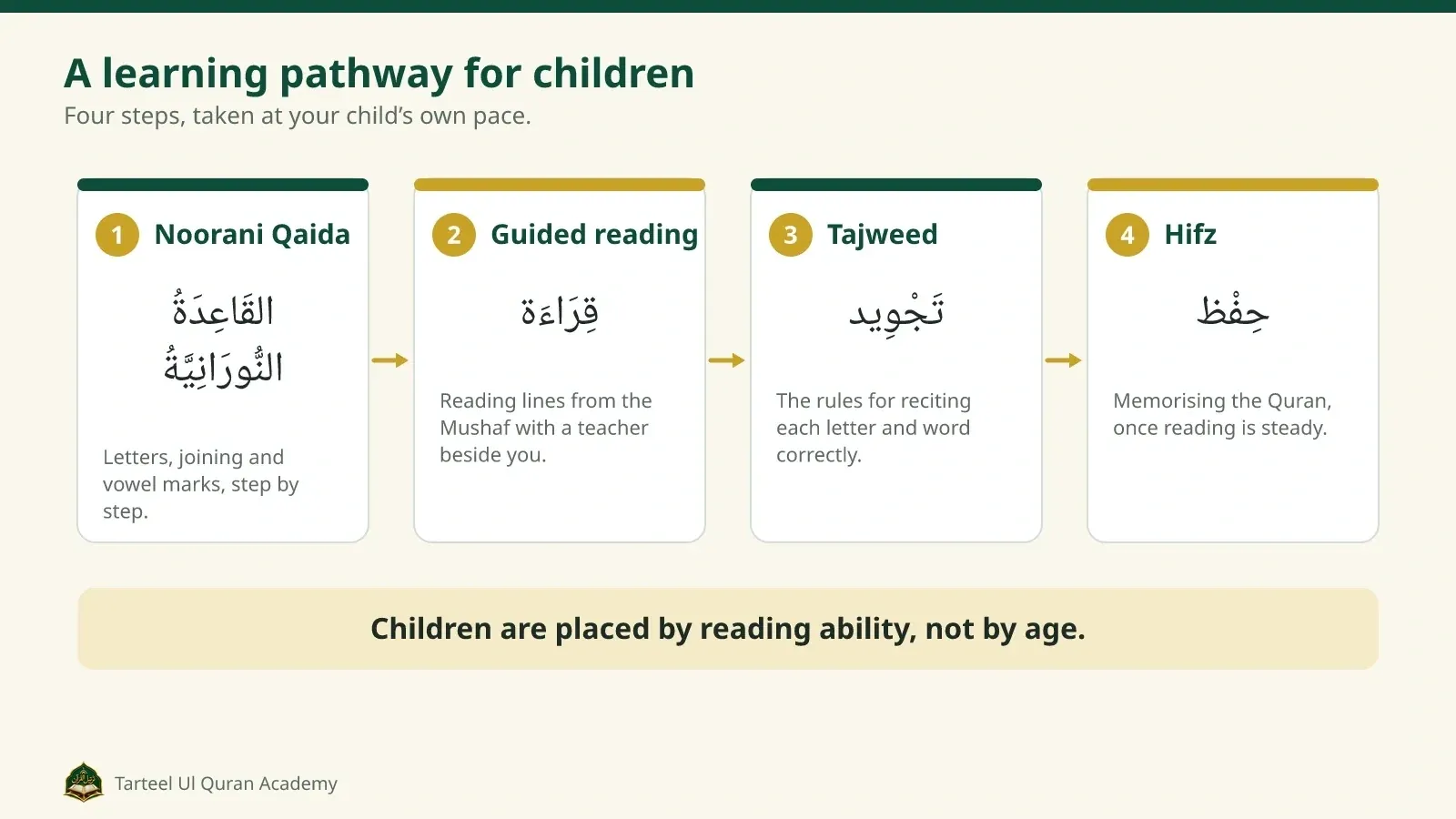
Where a child usually starts
| What your child can do now | Usual starting point | What to look for next |
|---|---|---|
| Does not know the letters, or knows a few | Noorani Qaida from the letters | Names and sounds all 28 letters |
| Knows letters, struggles with vowel marks or joined words | Qaida from the vowel or joining stage | Reads short joined words without spelling them out |
| Reads from the Mushaf slowly, letter by letter | Guided reading (nazra) | Reads a line smoothly, with fewer pauses |
| Reads fluently but rushes or skips rules | Tajweed | Applies ghunnah, madd and stopping signs |
| Reads well with basic Tajweed and wants to memorize | Hifz, starting with Juz ʿAmma | Keeps revision strong while adding new lines |
Is my child ready for Hifz?
A child is usually ready for Hifz when they read from the Mushaf steadily, apply the basic rules and can sit for a short daily routine of new lines and revision. Starting Hifz before reading is steady tends to lock in mistakes, so the teacher checks reading and Tajweed first.
For more on lessons shaped for children, see Quran classes for kids and how to help your child practise at home.
Placing an adult: letters, fluency, Tajweed or revision?
Adults usually fall into one of four groups, and each has a clear first step. Lessons are private, so you start exactly where you are, with nobody else listening.
Where an adult usually starts
| If this sounds like you | Start with |
|---|---|
| “I can’t read the Arabic letters yet.” | Quran Reading from the letters |
| “I learned as a child but have forgotten most of it.” | A quick Qaida refresher, then reading from the Mushaf |
| “I can read, but slowly, and I guess a lot.” | Guided reading to build fluency and accuracy |
| “I read fluently but never learned the rules.” | Tajweed, starting with makharij |
| “I memorized surahs years ago and they are slipping.” | Revision with Tajweed checks, then Hifz if you want more |
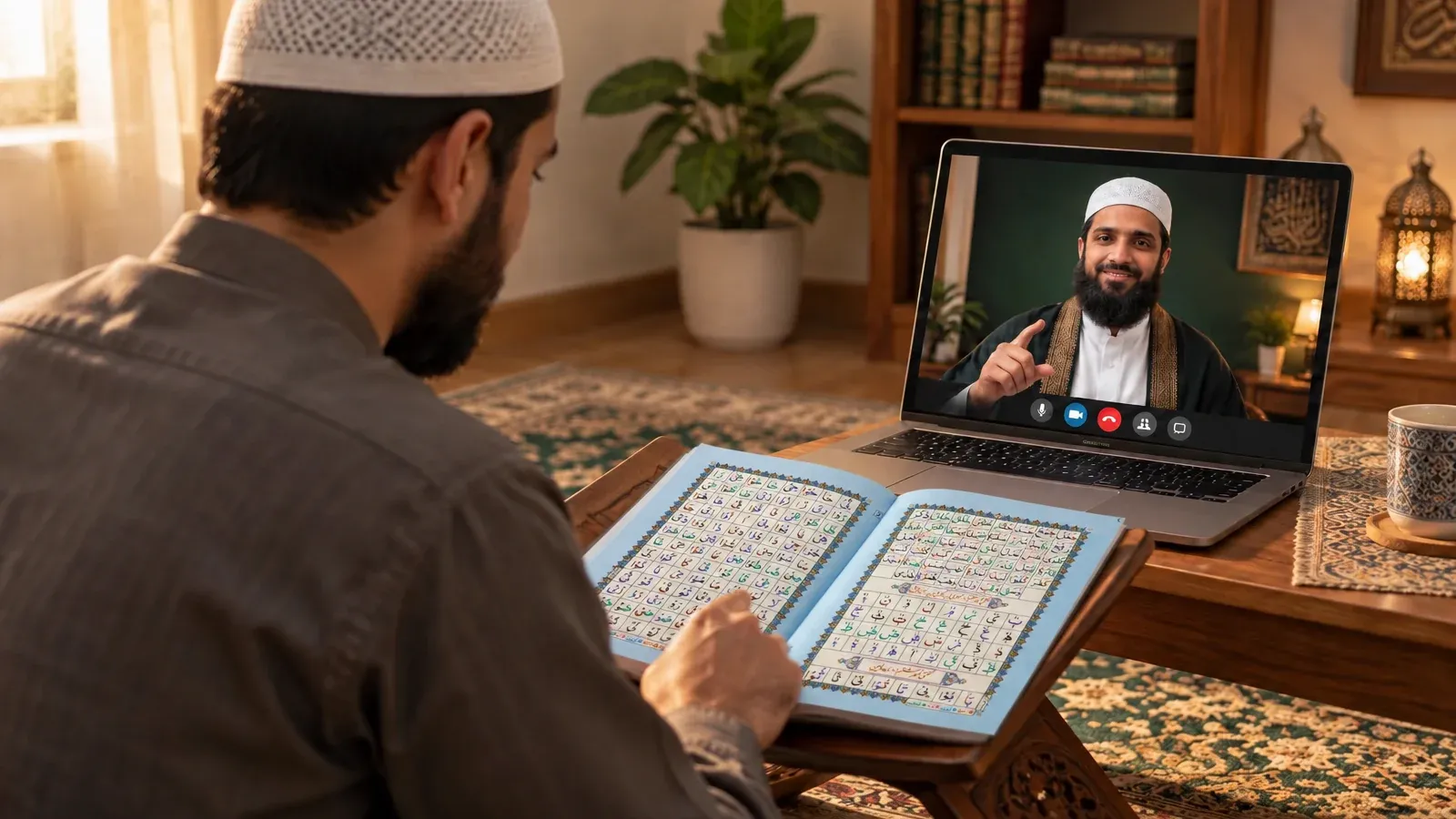
If you are new to Islam, start with the words of salah alongside the letters; our page on Quran lessons for new Muslims explains how. Adults who want more reassurance can read learning the Quran as an adult.
How the free lesson settles it
- Tell us who is learning. Choose a course in the form, or pick “Not sure yet”. Both are fine.
- A short reading check. In the lesson, you read a few letters or lines aloud. No preparation needed.
- A real mini-lesson. You learn something at your level, so you feel how lessons work.
- Your starting point. You leave with a recommended course and plan. Join only if it feels right.
Questions about choosing a level
Still unsure? Send us a message. Replies 7 days a week.
How many lessons a week should we take?
Three lessons a week suits most learners: enough to build momentum, with time to practise in between. Two a week works for busy schedules, and five suits Hifz or faster progress.
Which course should I start with?
If you cannot read Arabic yet, start with Quran Reading. If you read but want correct recitation, choose Tajweed. If you read well and want to memorize, choose Hifz. The free lesson confirms the right starting point.
Which recitation (riwayah) do you teach?
Lessons follow Hafs ʿan ʿĀsim, the most widely used recitation of the Quran today.
How do I know if my child is ready for Hifz?
A child is usually ready when they read from the Mushaf steadily, apply the basic Tajweed rules and can keep a short daily routine. Hifz begins with a reading and Tajweed check, so the teacher confirms readiness before memorization starts.
What if we choose the wrong course?
That is what the free lesson is for. A short reading check shows where you or your child should start, so you do not have to choose perfectly in advance. Choose “Not sure yet” in the form if you are unsure.
Should an adult who learned as a child start again from the beginning?
Not usually from the very beginning. Most adults who learned as children need a quick refresher of the Qaida stages they have forgotten, then reading practice from the Mushaf. The reading check in the free lesson shows how much to revisit.
Not sure where to start? One free lesson will tell you.
In a free 30-minute lesson, Muhammad checks your level honestly and gives you a clear plan, whether or not you join.
- Free 30-minute first lesson
- No card or payment needed
- Monthly plans, no long-term contract