
What you will learn, module by module
Every course follows a written syllabus with clear outcomes, so you always know what this stage is for and what comes next.
 By Muhammad Areeb · Reviewed
What does a Quran course syllabus cover?
A Quran course syllabus lists what a course teaches, in order, and what you should be able to do at the end of each stage. Ours moves from the 28 Arabic letters to reading from the Mushaf, then to Tajweed rules, Hifz with daily revision, and the meaning of what you recite.
- Courses
- Reading, Tajweed, Hifz, Quranic Arabic, Tafsir, Islamic studies
- Teacher
- Muhammad Areeb, every lesson
- Format
- Live 1-on-1, 30-minute lessons
- Recitation
- Hafs ʿan ʿĀsim
- Moving on
- When the stage is solid, not by the calendar
The order most learners follow, from first letter to fluent recitation
You do not have to start at the beginning. A short reading check in your free lesson shows which stage is yours.
Quran Reading syllabus: from the letters to the Mushaf
The Quran Reading course teaches complete beginners to read the Quran correctly from the Arabic letters, using the Noorani Qaida. By the end, you can read directly from the Mushaf, line by line, without transliteration. Typical timings below assume two or three lessons a week and short daily practice.
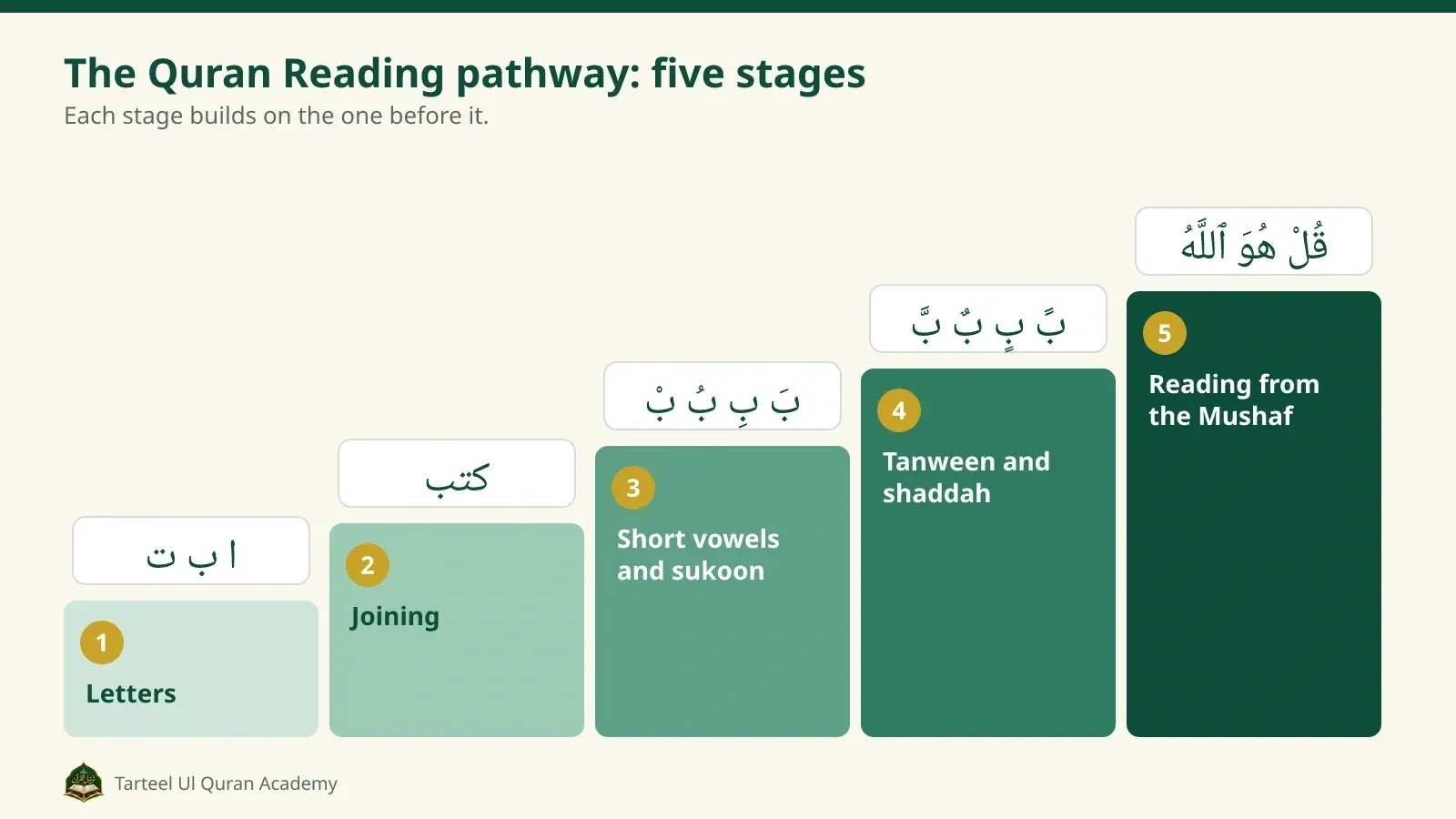
Quran Reading course modules
| Module | What it covers | Typical time |
|---|---|---|
| Letters and their sounds | The 28 letters; makharij; heavy and light letters; letters that are easily confused, such as ح and ه | 3 to 6 weeks |
| Joining letters | Letter shapes at the start, middle and end of words; two- and three-letter combinations | 2 to 4 weeks |
| Short vowels and sukoon | Fatha, kasra and damma; sukoon and joining syllables; short words | 3 to 5 weeks |
| Tanween, shaddah and long vowels | Double vowel marks, doubled letters, madd letters (alif, waw, ya), soft letters | 3 to 5 weeks |
| From the Qaida to the Mushaf | Short surahs from Juz ʿAmma; stopping and starting; first Tajweed rules in context | 2 to 4 months |
Learning outcomes
- Recognise and pronounce all 28 Arabic letters from their correct points of articulation.
- Read words with fatha, kasra, damma, sukoon, shaddah and tanween.
- Read long and short vowels correctly.
- Read directly from the Mushaf, line by line, without transliteration.
- Apply the first rules of ghunnah and qalqalah while reading.
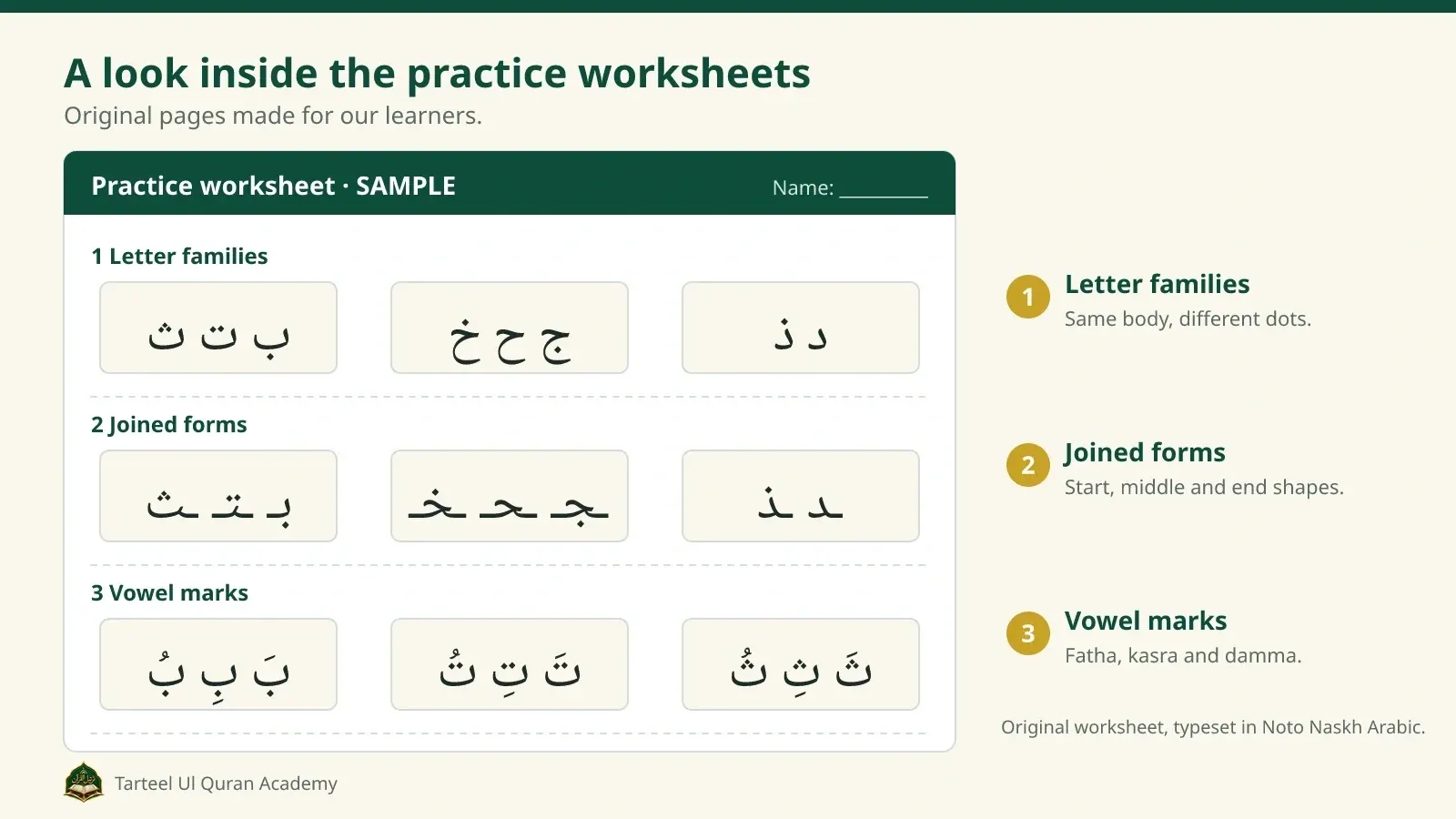
Read more in the Quran Reading course or the Noorani Qaida guide.
Tajweed syllabus: the rules of recitation, applied
The Tajweed course is for learners who can already read and want to recite correctly. It works through the rules in the order they appear most often, and every rule is practised in real verses rather than lists.
Tajweed course modules
| Module | What it covers | Typical time |
|---|---|---|
| Articulation (makharij and sifat) | The five areas of articulation; throat and heavy letters; qualities that separate similar letters | 4 to 6 weeks |
| Noon sakinah and tanween | Izhar, idgham (with and without ghunnah), iqlab before ب, ikhfa | 3 to 4 weeks |
| Meem sakinah, ghunnah and qalqalah | Ikhfa, idgham and izhar for meem sakinah; noon and meem with shaddah; the five qalqalah letters | 2 to 3 weeks |
| Madd (elongation) | Natural madd of two counts; connected and separated madd; madd before a sukoon and when stopping | 3 to 4 weeks |
| Heavy and light sounds | Tafkhim and tarqiq; the rules of ra; the lam in the name Allah | 2 to 3 weeks |
| Stopping and fluency | Waqf signs in the Mushaf; stopping and restarting; applying every rule across longer passages | Ongoing |
Learning outcomes
- Pronounce every letter from its correct makhraj with its essential qualities.
- Apply izhar, idgham, iqlab and ikhfa for noon sakinah and tanween.
- Apply the rules of meem sakinah, ghunnah and qalqalah.
- Hold each type of madd for the correct number of counts.
- Stop and restart correctly using the waqf signs in the Mushaf.
- Recognise and avoid the clear errors that change letters or meaning.
See the Tajweed course, or start with what Tajweed is and the makharij.
The other four syllabuses at a glance
Quran Memorization (Hifz)
Hifz starts with a reading and Tajweed check, then Juz ʿAmma from Surat an-Nas backwards, before structured Hifz with three daily parts: new lines (sabaq), recent revision (sabqi) and long-term revision (manzil). Juz ʿAmma often takes three to six months.
- Follow a weekly plan of new memorization, recent revision and long-term revision.
- Recite memorized portions from memory with correct Tajweed.
- Keep earlier portions strong while adding new ones.
Quranic Arabic
Quranic Arabic begins with the words of salah and al-Fatihah, then three-letter roots and patterns, verbs, sentences and finally reading Juz ʿAmma word by word. It is built for understanding what you recite, not conversation.
- Understand al-Fatihah and the main words recited in daily prayer.
- Recognise common roots and the patterns built from them.
- Follow a word-by-word translation and see how it forms a sentence.
Quran Translation and Tafsir
This course moves from how the Quran was revealed and compiled, through the surahs of daily prayer and Juz ʿAmma, to passages you choose, using established translations and named classical tafsir works.
- Explain the main themes of the surahs you study.
- Connect what you recite in salah to its meaning.
Islamic Studies
Islamic Studies covers belief, worship (wudu and salah step by step), everyday duas, the life of the Prophet ﷺ and good character, taught for children, adults and new Muslims.
- Perform wudu and salah correctly, with understanding.
- Know the pillars of iman and the five pillars of Islam.
- Learn everyday duas and their meanings.
Terms in these syllabuses are defined in the Quran course glossary.
You move on when a stage is solid, not when the calendar says so
There are no surprise exams. Progress is checked the same calm way in every lesson.
- Review first. Each lesson starts with the last lesson’s work, so gaps show up early.
- Heard and corrected. You read aloud; every sound is heard and corrected as it happens.
- Mixed-order check. Before a new stage, you read the current one in a mixed order, without guessing.
- Short progress notes. Notes after lessons say what was covered, what to practise and what comes next.
All courses side by side
- Quran Reading for Beginners (Noorani Qaida)Beginner · Often 6–12 monthsLearn to read the Quran from the very first letter: the Arabic alphabet, correct sounds, vowels and joining, then fluent reading from the Mushaf.
- Quran Tajweed CourseIntermediate · Often 4–8 months for the core rulesRecite the Quran correctly: precise articulation, the rules of noon and meem sakinah, madd, qalqalah and stopping, applied in your own recitation.
- Quran Memorization (Hifz) CourseIntermediate · Months for Juz ʿAmma, years for the full QuranMemorize the Quran with a structured plan: new lines, recent revision and long-term revision every week, with a teacher checking every word.
- Quranic Arabic CourseBeginner · Often 6–12 months for the foundationsUnderstand the words you recite. Build vocabulary from frequent Quranic words and learn the grammar patterns that unlock meaning.
- Quran Translation & TafsirBeginner · Ongoing, at your paceStudy the meaning and context of the Quran surah by surah, using established translations and classical tafsir, with time for your questions.
- Islamic Studies for Kids & AdultsBeginner · Ongoing, in short unitsThe essentials of faith and practice: belief, salah, duas, seerah and character, taught by a university Islamic studies instructor.
- Quran Recitation CourseIntermediate · Often 3–6 months for steady fluency, then ongoing practiceFor readers who want fluent, accurate, unhurried recitation: steady pacing, correct stopping and starting, and Tajweed kept across longer passages.
Questions about courses and levels
Still unsure? Send us a message. Replies 7 days a week.
How many lessons a week should we take?
Three lessons a week suits most learners: enough to build momentum, with time to practise in between. Two a week works for busy schedules, and five suits Hifz or faster progress.
Which course should I start with?
If you cannot read Arabic yet, start with Quran Reading. If you read but want correct recitation, choose Tajweed. If you read well and want to memorize, choose Hifz. The free lesson confirms the right starting point.
Which recitation (riwayah) do you teach?
Lessons follow Hafs ʿan ʿĀsim, the most widely used recitation of the Quran today.
How do I know if my child is ready for Hifz?
A child is usually ready when they read from the Mushaf steadily, apply the basic Tajweed rules and can keep a short daily routine. Hifz begins with a reading and Tajweed check, so the teacher confirms readiness before memorization starts.
What if we choose the wrong course?
That is what the free lesson is for. A short reading check shows where you or your child should start, so you do not have to choose perfectly in advance. Choose “Not sure yet” in the form if you are unsure.
Should an adult who learned as a child start again from the beginning?
Not usually from the very beginning. Most adults who learned as children need a quick refresher of the Qaida stages they have forgotten, then reading practice from the Mushaf. The reading check in the free lesson shows how much to revisit.
Find your stage in one free lesson. Book it in a minute.
In a free 30-minute lesson, Muhammad checks your level honestly and gives you a clear plan, whether or not you join.
- Free 30-minute first lesson
- No card or payment needed
- Monthly plans, no long-term contract