
Planning your Quran lesson schedule
Regular 30-minute lessons at the same times each week beat an ambitious plan that falls apart by week three. Here is how to choose.
 By Muhammad Areeb · Reviewed
How many Quran lessons a week should we book?
Three lessons a week suits most learners: enough to build momentum, with time to practise in between. Two a week works for busy schedules, and five suits Hifz or faster progress. Whatever you choose, keep the same days and times each week and add about ten minutes of practice on the other days.
- Most learners
- 3 lessons a week
- Busy weeks
- 2 lessons a week
- Hifz or faster progress
- 5 lessons a week
- Lesson length
- 30-minute
- Between lessons
- About 10 minutes of practice
How to choose lesson times your family can keep
The best lesson time is one you can keep every week without rearranging your life. Attach lessons to something that already happens at the same time each day, and avoid the hours when the learner is usually tired, hungry or rushing.
For children
- After school works well once your child has had a snack and a short break; straight off the bus rarely does.
- Young children focus best earlier in the evening. Late slots often end in yawns.
- Keep lessons on the same days as other routines, such as homework, so they feel normal.
- Plan ahead for exam weeks and school holidays, when routines change.
For adults
- Before work, after Fajr, suits early risers and leaves the evening free.
- A fixed evening slot works if you protect it like any other appointment.
- Weekend lessons suit shift workers and parents, but keep a short weekday practice.
Around prayer times and Ramadan
Choose times that do not clash with the prayers you pray on time, and remember that prayer times move through the year. Many families change lesson times during Ramadan; it helps to agree the Ramadan schedule a few weeks before it begins.
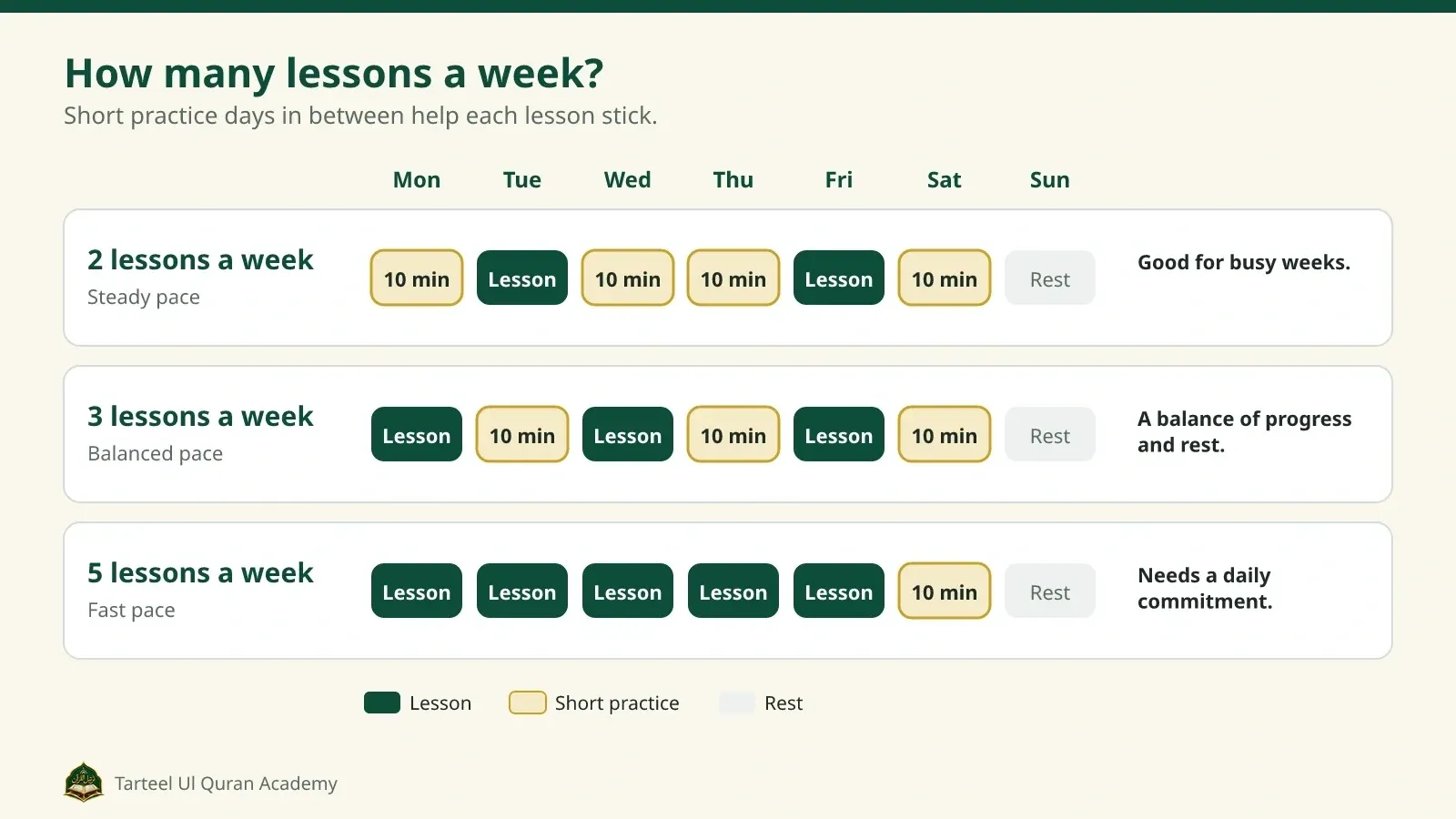
Three common schedules
| Schedule | Suits | Practice on other days |
|---|---|---|
| 2 lessons a week (for example Tuesday and Saturday) | Busy families, adults working full time | 10 minutes, four or five days |
| 3 lessons a week (for example Monday, Wednesday, Friday) | Most children and adult beginners | 10 minutes on the other days |
| 5 lessons a week (weekdays) | Hifz, or learners who want faster progress | Revision at weekends |
Lesson times, shown in your time zone
Every lesson is live, so it helps to see when they can happen where you live. Pick your city to see the teaching hours on your own clock.
Times update for daylight saving automatically.
Teaching hours in London
- Mon
- 10am–6pm
- Tue
- 10am–6pm
- Wed
- 10am–6pm
- Thu
- 10am–6pm
- Fri
- 10am–6pm
- Sat
- 5am–5pm
- Sun
- 5am–5pm
How lessons work across time zones and clock changes
Lessons are arranged in your time zone. The lesson times on this site convert to your local time automatically, and when you book you tell us when suits you where you live, so you never have to do the maths.
The one thing to watch is clock changes. Countries change their clocks on different dates, and some do not change them at all. In the week your clocks go forward or back, check your lesson time with Muhammad so nobody is waiting on an empty call.
- Save lesson times in your phone calendar in your own time zone.
- Note the weeks your clocks change and send a quick message that week.
- Travelling? Tell Muhammad your new time zone before you go.

From free lesson to a regular weekly time
- Tell us when suits you. Choose mornings, afternoons, evenings or weekends in the form, in your time zone.
- Agree a trial time. Muhammad replies within 24 hours, usually on WhatsApp, to agree a time.
- Try a lesson. A relaxed 30-minute lesson on Zoom.
- Fix your weekly slots. If you continue, you agree regular days and times from the slots that are free.
Times, changes and missed lessons
Still unsure? Send us a message. Replies 7 days a week.
Are the classes one-on-one?
Yes. Every lesson is live and one-on-one: one teacher and one learner. Siblings each have their own lessons, usually back to back, so every child gets full attention.
How do online Quran classes work?
You meet your teacher on Zoom for a live 30-minute lesson. The Qaida or Mushaf is shared on screen, your teacher listens as you read and corrects each sound as it happens, and you finish with a short note on what to practise.
Which countries do you teach in?
Any country with a stable internet connection. Times are arranged in your own time zone, whether you are in the UK, the US, Canada, Europe, Australia or the Gulf.
How will I know my child is making progress?
You get short progress notes after lessons: what was covered, what to practise and what comes next. You can message Muhammad with questions at any time.
Can I learn in the evenings or at weekends?
Yes. Evening and weekend lessons are available in most time zones. The lesson times on this site are converted to your local time automatically.
What do I need for online lessons?
A laptop or tablet with a camera and microphone, a stable internet connection and Zoom. Headphones help, especially for children. A phone works, but a bigger screen makes reading easier.
What happens if we miss a lesson?
Let Muhammad know as early as you can and the lesson can usually be moved to another time in the same week. Lessons missed without notice may not be made up.
How many lessons a week should we take?
Three lessons a week suits most learners: enough to build momentum, with time to practise in between. Two a week works for busy schedules, and five suits Hifz or faster progress.
Tell us when suits you. Let’s find a time that works.
In a free 30-minute lesson, Muhammad checks your level honestly and gives you a clear plan, whether or not you join.
- Free 30-minute first lesson
- No card or payment needed
- Monthly plans, no long-term contract