
You will always know what was covered and what comes next
Progress is checked in every lesson and shared in a short note afterwards, so learners and parents can see exactly where things stand.
 By Muhammad Areeb · Reviewed
How is progress tracked in online Quran classes?
Each lesson starts by reviewing the last one, and every sound is corrected as the learner reads. After lessons you get a short progress note: what was covered, what to practise and what comes next. You can message Muhammad with questions at any time, and for children every message goes to the parent.
- In the lesson
- Review, live correction, new work
- After lessons
- A short written progress note
- Note covers
- Covered, practise, next step
- For children
- All messages go to parents
- Questions
- Message Muhammad any time
Three things, in a few lines
Notes are short on purpose. You should be able to read one in under a minute and know what to do before the next lesson.
- What was covered. The page, letters, rule or verses worked on, and how it went.
- What to practise. One or two specific things for the days in between, such as a line to repeat.
- What comes next. The next step, so nobody is surprised when the lesson moves on.
A sample progress note (fictional learner)
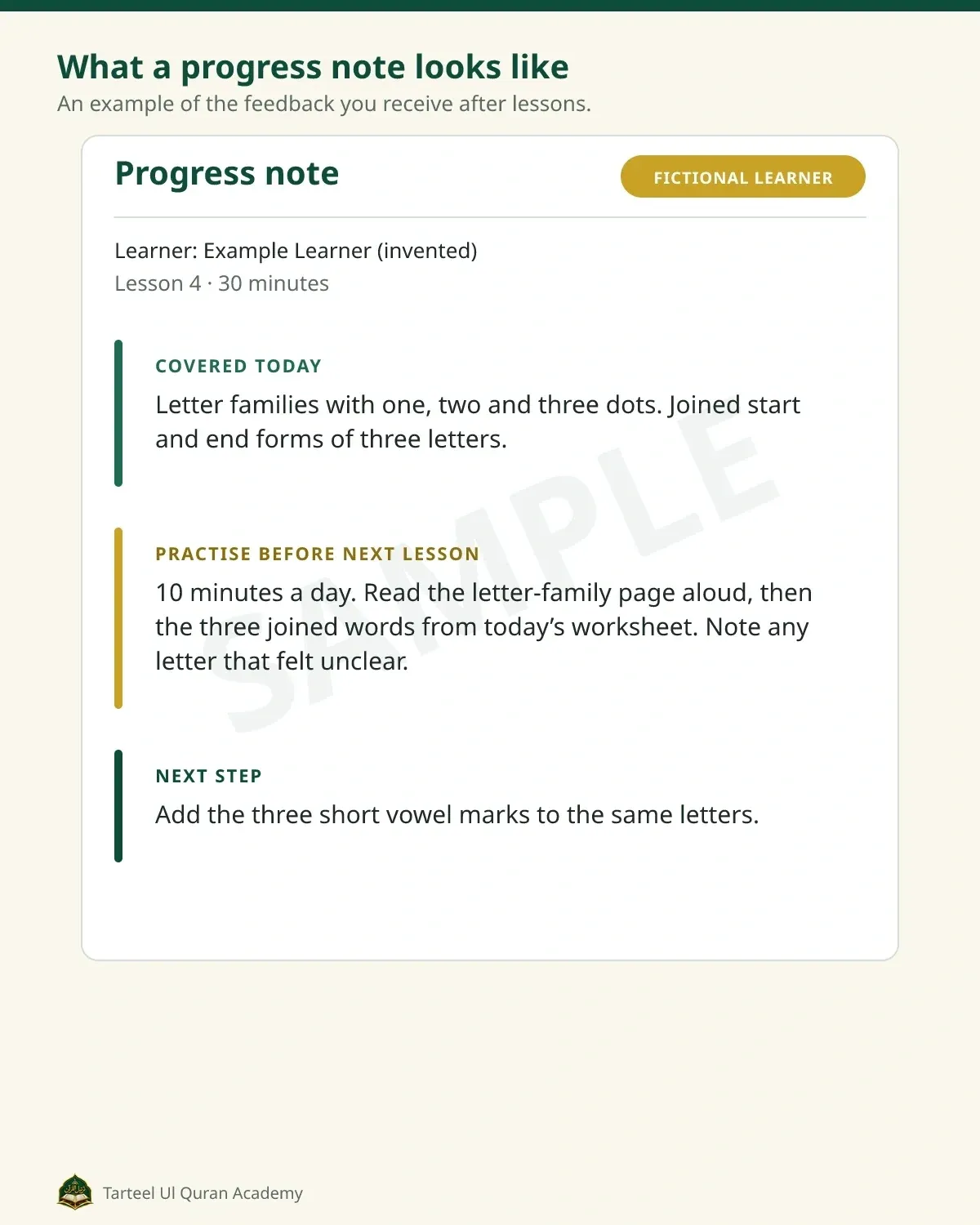
Real notes follow the same three parts. For adult learners, the note goes to you; for children, it goes to the parent who booked.
How we decide when a learner is ready for the next stage
A learner moves on when they can read the current stage in a mixed order, steadily and without guessing, and the sounds are right. It is not decided by the calendar. Some stages take a week, some take three; both are normal.
- The last lesson’s work is read again at the start of each lesson.
- Before a new stage, the current one is read in a different order from the page.
- Small, repeated mistakes are noted and practised before moving on, so they do not settle into habits.
The stages themselves are listed in the course syllabus, with typical timings for each.
How parents and the teacher stay in touch
When a child is learning, the parent is the contact for everything: scheduling, progress notes and questions. All messages about scheduling and progress go to parents, never directly to children. Parents are welcome to sit in on lessons, especially in the first weeks.
Parent communication at a glance
| What | How |
|---|---|
| Arranging and moving lessons | Parent and Muhammad, on WhatsApp or email |
| Progress notes | Sent to the parent after lessons |
| Questions or worries | Message Muhammad at any time |
| Sitting in on lessons | Welcome, especially in the first weeks |
To support practice at home between lessons, see our guide on helping your child practise Quran at home.
Questions about progress and updates
Still unsure? Send us a message. Replies 7 days a week.
What will a progress note tell me?
Three things: what was covered in the lesson, what to practise before the next one, and what comes next. Notes are short so you can read them in under a minute and act on them.
Can I ask how my child is doing between progress notes?
Yes. Message Muhammad at any time with questions. For children, all messages about scheduling and progress go to the parent, never directly to the child.
What should my child have ready for each lesson?
A laptop or tablet at eye level, headphones that fit, their Qaida or Mushaf, a pencil and a glass of water, in a quiet spot within earshot of a parent. Turning off notifications helps them focus.
How do I know if my child is ready for Hifz?
A child is usually ready when they read from the Mushaf steadily, apply the basic Tajweed rules and can keep a short daily routine. Hifz begins with a reading and Tajweed check, so the teacher confirms readiness before memorization starts.
Do you contact children directly?
No. When a child is learning, all messages about scheduling and progress go to the parent, never directly to the child. Parents are welcome to sit in on lessons.
See how lessons and progress notes work. Try a free lesson.
In a free 30-minute lesson, Muhammad checks your level honestly and gives you a clear plan, whether or not you join.
- Free 30-minute first lesson
- No card or payment needed
- Monthly plans, no long-term contract