
How to Practise Quran Reading Without Feeling Overwhelmed
A calm 10-minute routine for practising Quran reading foundations: one small target, letters in families, harakat on shapes you already know and a simple log that shows progress.

Muhammad AreebUpdated · 10 min read
The short version
- Ten focused minutes every day helps more than one long weekend session.
- Pick one target per session, such as five letters or one line.
- Practise joined forms in families that share a shape.
- Always read aloud and finish on something you read well.
To practise Quran reading without feeling overwhelmed, keep sessions to about 10 minutes, choose one small target, and read aloud. Warm up with yesterday's line, practise joined letter forms in families, add harakat only to shapes you already know, and finish on a line you read well. Log it, then stop.
You open the Qaida, see a page with forty letter combinations, read three lines and feel your shoulders creep up towards your ears. That feeling is common, and it is rarely about ability. It is usually about trying to do the whole page, silently, in one go, with no clear point at which you are allowed to stop.
This guide breaks Quran reading practice into small, repeatable steps for getting started readers, adults and children alike. It assumes you have begun the Noorani Qaida or a similar primer, and it fits around lessons in a Quran reading course. If you have not started yet, read what beginners often misunderstand about Quran reading foundations first.
Why does Quran reading practice feel overwhelming?
Quran reading practice feels overwhelming when the target is too big, the session has no end point, or practice happens silently. A full Qaida page holds dozens of new combinations, so trying to master it in one sitting turns every mistake into a reason to stop. Smaller targets and a fixed time change that.
- The target is a whole page instead of one line or a handful of letters.
- There is no finish line, so the session ends when you feel tired or discouraged.
- Practice is silent, so the tongue never trains and mistakes stay hidden.
- New material piles up before the previous page is smooth.
Nobody has ever become fluent by staring at a page silently and hoping it would read itself. Each fix below answers one of these causes, and none of them needs more than a few minutes. Allah says He has made the Quran easy to remember (Quran 54:17); the steps below simply make the practice easy to start.
What do you need before you start practising?
You need very little to practise Quran reading at home: your Qaida or lesson page, a pencil, a timer, a quiet spot and a simple log. The timer matters more than it seems, because it gives the session a clear end and makes stopping feel planned rather than like giving up.
- Your Qaida or the page your teacher set, on a rehal or a clean raised surface.
- A pencil to point with and to mark letters you want to ask about.
- A timer set to 10 minutes.
- A practice log: one line per day (a printable version is below).
- The same time each day, such as after Fajr or before dinner.
How to practise Quran reading in 10 minutes a day: 7 steps
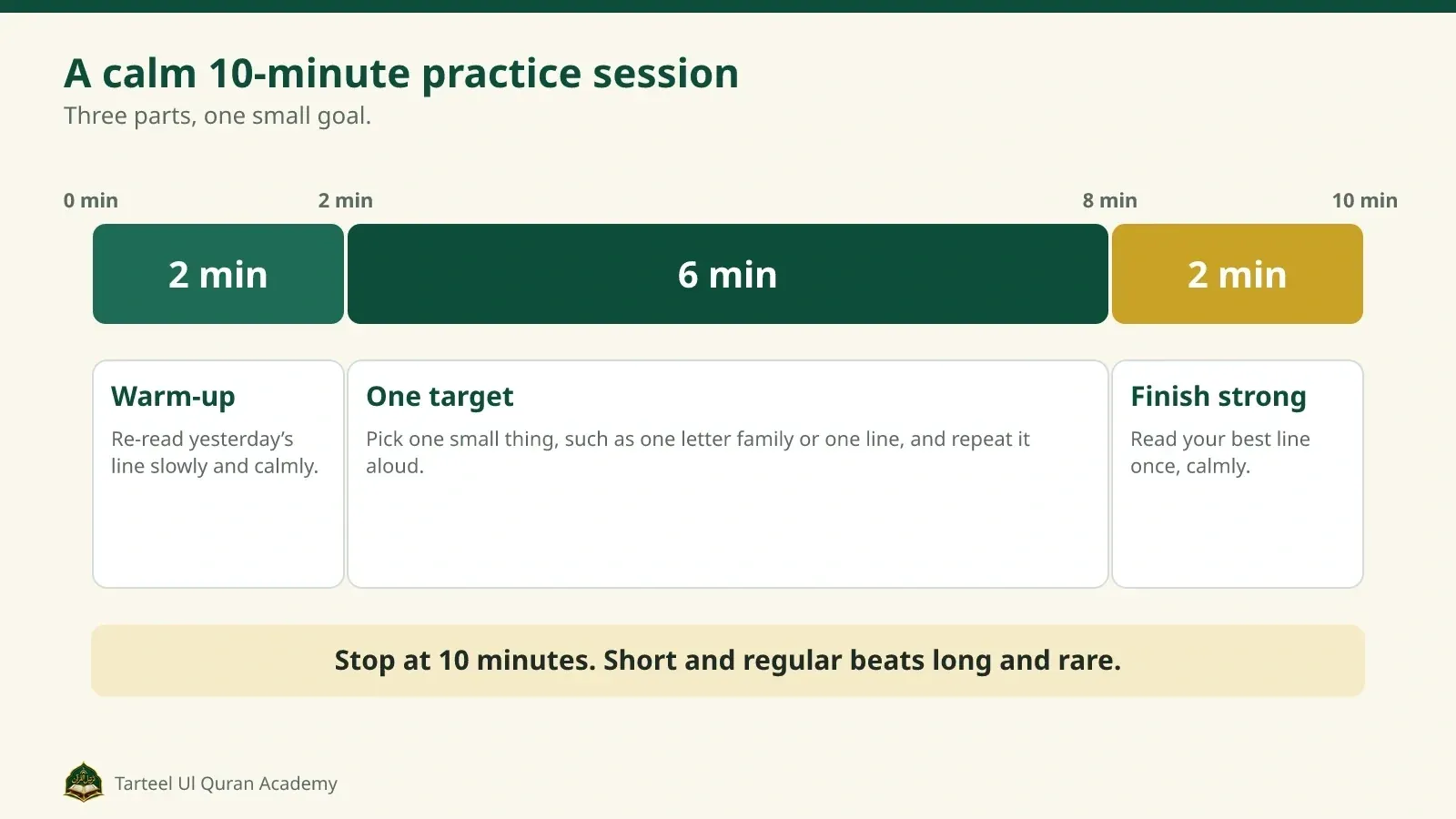
Practise Quran reading in seven short steps, in this order, every session. The first two take about two minutes, the middle three take about six, and the last two take about two. The order matters: warming up builds confidence, and finishing on a success makes tomorrow's session easier to start.
- Set one small target for the session
- Warm up with yesterday's line
- Practise joined forms in letter families
- Add harakat only to shapes you know
- Read aloud and point to each letter
- Finish on a line you read well
- Log the session in one line
Step 1: Set one small target for the session
A small target makes practice feel finishable. Choose one: five letters, one line of joined forms, or one row of vowel marks. Write it at the top of your log before you start. Five letters read well is a better day than forty letters read in a hurry, even if the forty felt more heroic.
Step 2: Warm up with yesterday's line
Start every session by reading the last line you practised, aloud, twice. Warm-up revision reminds your tongue of the sounds and shows you that yesterday's work stuck. If the line is still shaky, that line becomes today's target, which is perfectly normal.
Step 3: Practise joined letter forms in families
Joined letter forms are easiest to practise in letter families: Arabic letters that share a shape. At the start of a word, in the initial form, the five tooth letters ب ت ث ن ي all begin with the same small tooth shape, and only the dots tell them apart. Practise the family together, then notice how each one ends.
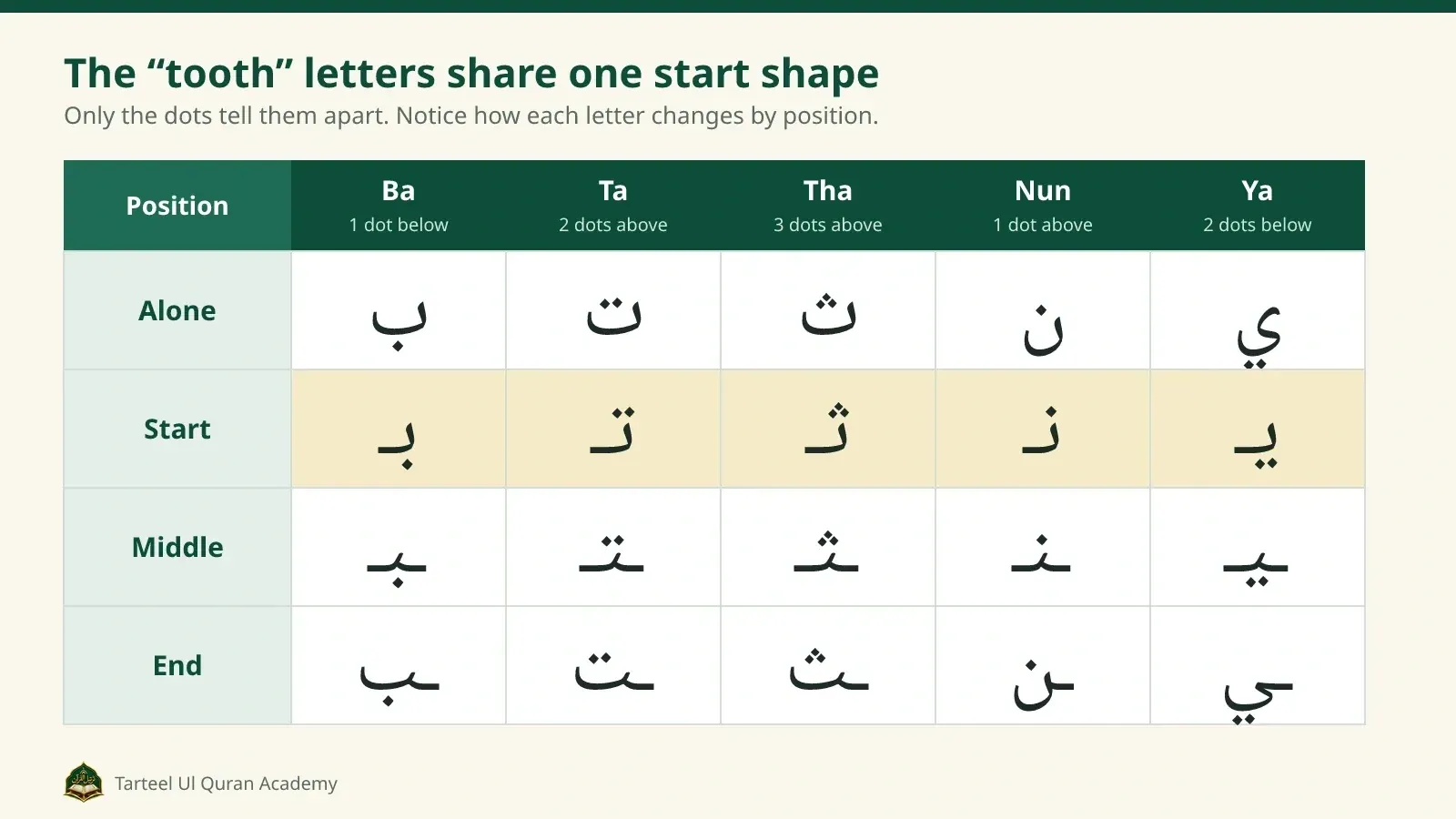
Their start forms are بـ تـ ثـ نـ يـ. The medial form (in the middle of a word) looks almost the same. Their final form, at the end of a word, separates more: ـن and ـي look quite different from ـب. Other useful families are ج ح خ, ع غ and ف ق. The Quran Reading Basics flashcards are a quick way to revise them away from the desk.
Step 4: Add harakat only to shapes you know
Add harakat and short vowels to letters you already recognise, so you are only learning one new thing at a time. Once the tooth letters feel easy, read them with fatha (بَ تَ ثَ), then kasra (بِ تِ ثِ), then damma (بُ تُ ثُ). Change only the mark, and keep the letters the same. The names of these marks are fixed in the Unicode Arabic chart, so you will see the same names in every Qaida and app.
When a letter is still unfamiliar, practise it without marks first. Mixing a new letter with a new mark doubles the load and is one of the main reasons pages feel overwhelming.
Step 5: Read aloud and point to each letter
Read every letter aloud and point to it with a pencil as you say it. Reading aloud trains the tongue, and pointing keeps your eyes from skipping ahead or guessing the next letter from its neighbours. Say each sound clearly, even when it feels slow.
If a sound feels wrong, mark the letter lightly with the pencil and move on. Our guide to makharij al-huruf shows where each sound comes from, and your teacher can check the marked letters in the next lesson.
Step 6: Finish on a line you read well
End every session by reading one line you can read well, even if it is from last week. Finishing on a success is a small habit with a big effect: you leave the desk feeling capable, and that feeling is what brings you back tomorrow.
Step 7: Log the session in one line
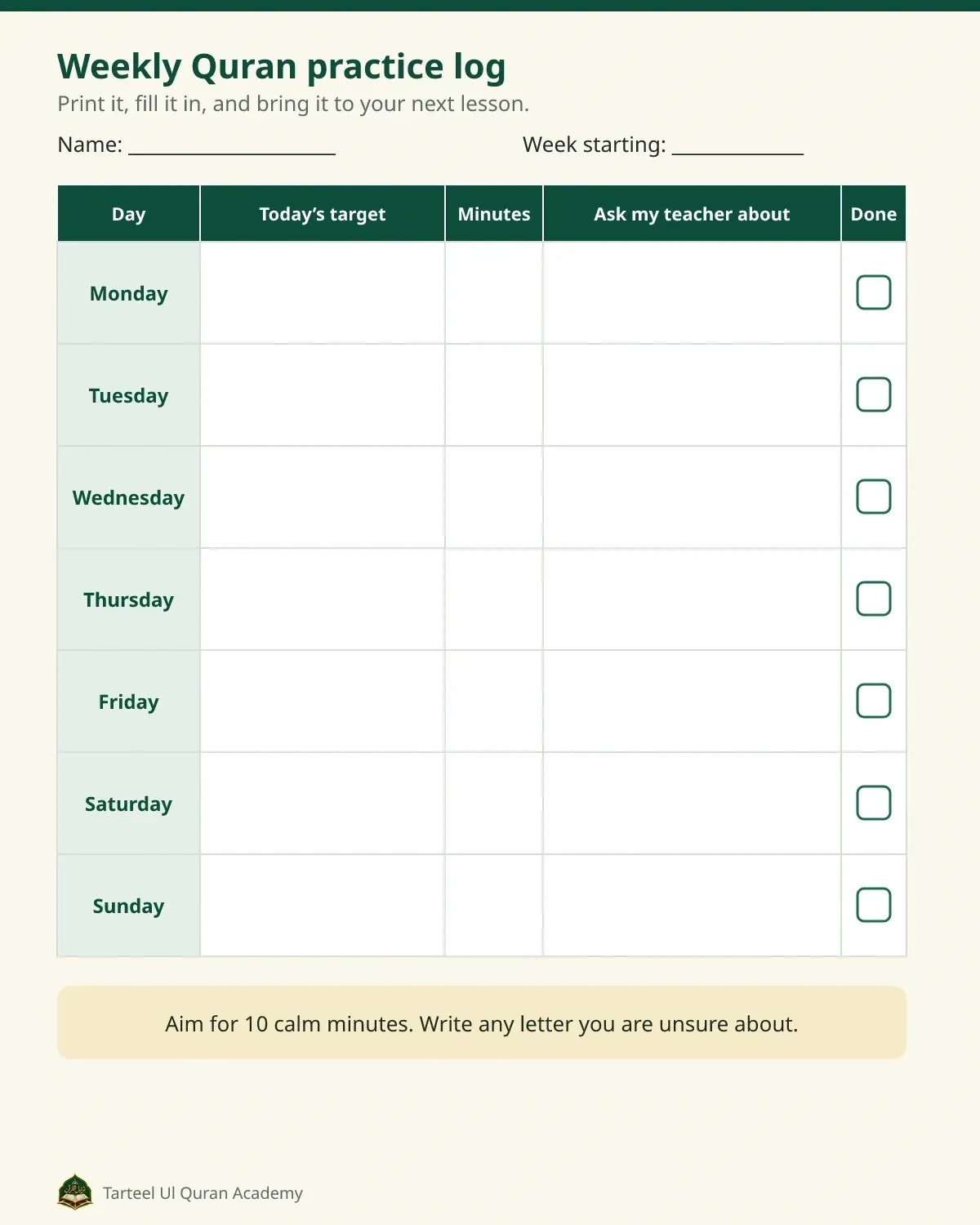
Write one line in your practice log: the target, the minutes and any letter to ask about. Over a week, the log shows progress that is hard to feel day by day, and it gives your teacher a clear picture at the start of the next lesson.
Most of us have a Qaida page with a pencil mark that says start here, dated some months ago. That is fine; today counts.
What does a calm practice week look like?
A calm practice week has one focus per day, about 10 minutes each, with a lighter review day and a rest day. The sample below assumes a learner working on the tooth letters and the three short vowels. Swap in whatever your teacher has set.
A sample practice week (adjust to your own lessons)
| Day | Focus | Time |
|---|---|---|
| Monday | Tooth letters, start forms: بـ تـ ثـ نـ يـ | 10 minutes |
| Tuesday | Same letters, end forms | 10 minutes |
| Wednesday | Tooth letters with fatha | 10 minutes |
| Thursday | With kasra and damma | 10 minutes |
| Friday | Review the whole week, one read each | 10 minutes |
| Saturday | Lesson day or light revision | 10 minutes |
| Sunday | Rest, or listen to a slow recitation | Optional |
The Prophet ﷺ said the most beloved deeds to Allah are the most regular, even if small (Sahih al-Bukhari 6464). A steady 10 minutes is exactly that kind of consistency.
What should you do when a page still feels like too much?
When a page still feels like too much, make the target smaller rather than the session longer. Split the page into single lines, go back to the last stage that felt easy for a day, or ask your teacher to set a shorter page. Each of these keeps you moving without the weight of the full page.
Signs of overwhelm and what to change
| Sign | What it usually means | What to change |
|---|---|---|
| You keep restarting the same line | Too many new letters in one line | Practise the new letters alone first |
| You guess letters from their neighbours | Reading too fast | Point with a pencil and slow down |
| You dread opening the Qaida | Sessions are too long or end badly | Ten minutes, finish on a strong line |
| Marks feel random | New letters and new marks together | Add marks only to letters you know |
| Progress feels invisible | No record of what you did | Use the practice log every day |
The Prophet ﷺ also said that the one who recites with difficulty has a double reward (Sahih Muslim 798). Difficulty is part of the path, not a sign you are on the wrong one.
How can parents help a child practise without pressure?
Parents help most by keeping the routine and the mood, not by correcting every sound. Sit nearby, start the timer, listen to your child read aloud and praise the effort. Leave detailed correction to the teacher, and share any letters that keep causing trouble before the next lesson.
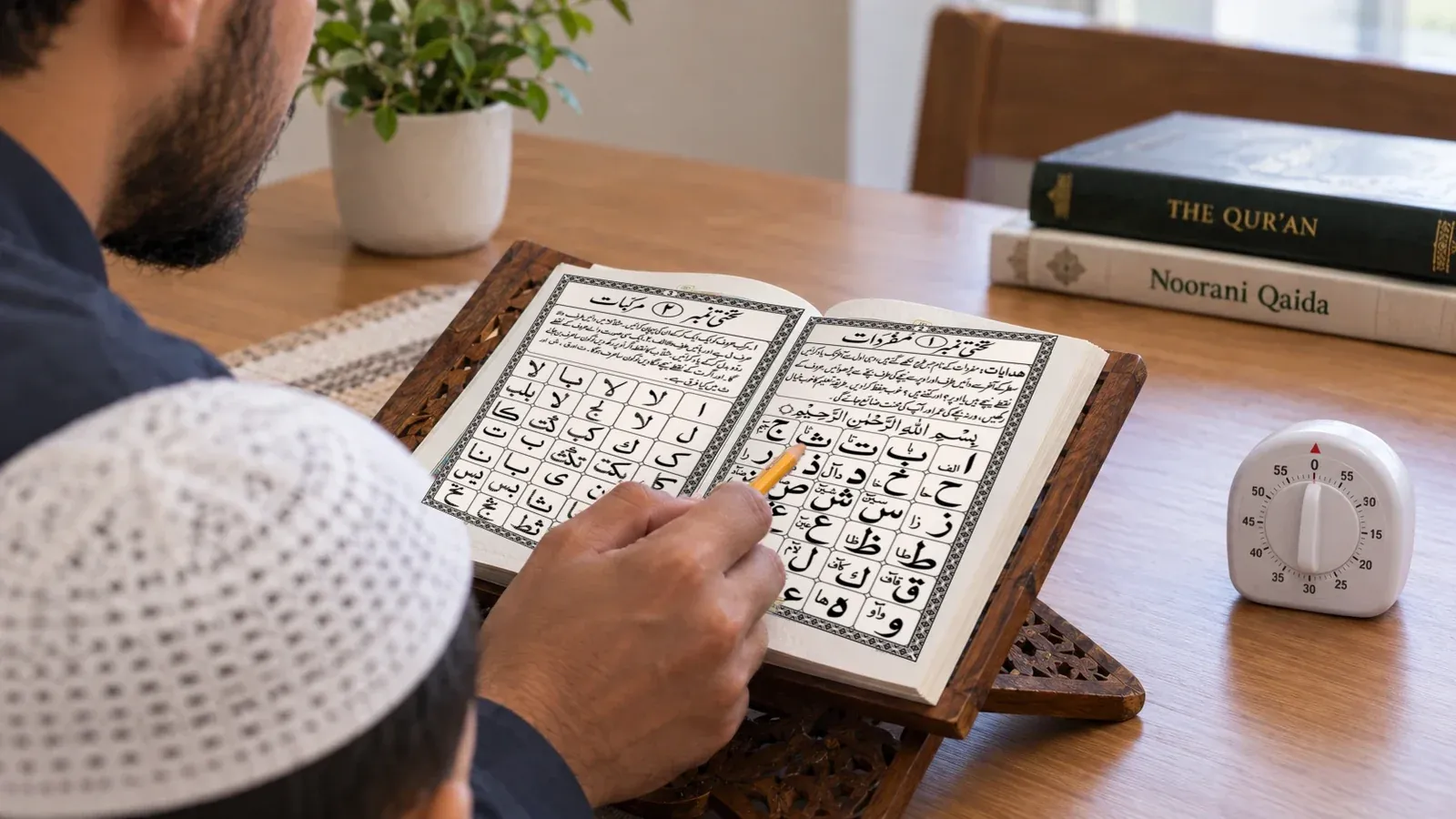
Young children usually need even shorter sessions. Our guide to helping your child practise Quran at home gives practice times by age and what to listen for, and Quran classes for kids explains how lessons are shaped for children.
Frequently asked questions
How long should I practise Quran reading each day?
About 10 minutes a day suits most beginners, with a little less for young children. Short daily sessions build the habit and train the tongue without tiring you out. Longer sessions are fine once reading feels steady, but regular practice matters more than length.
Should I practise Quran reading silently or aloud?
Aloud, always. Silent reading does not train your tongue, and it hides mistakes you would otherwise hear. Read each letter clearly, point to it as you go and mark any sound you are unsure of so your teacher can check it.
What is the best way to practise joined letter forms?
Practise joined forms in families that share a shape, such as the tooth letters ب ت ث ن ي, which begin with the same shape and differ by dots. Read the start forms first, then the middle and end forms, and only then add vowel marks.
When should I start practising harakat and short vowels?
Start once you recognise the letters without hesitation. Add one mark at a time, usually fatha, then kasra, then damma, to letters you already know. If a letter is still new, practise it without marks for a few days first.
What if I miss a few days of practice?
Start again with a short warm-up on the last line you practised. Missing days is normal. Go back one small step rather than trying to catch up, and keep the next few sessions short so the habit returns.
What is the next step after building a practice routine?
Once a 10-minute routine feels normal, the next step is a clear plan for the weeks ahead, so each session builds on the last. Practise Quran reading on the same days and times as your lessons fit, and let your teacher set the targets.
- Print or copy the practice log and fill in the line for today.
- Follow our realistic first-month plan for the next four weeks.
- Book a free trial lesson if you do not have a teacher yet.
Not sure which stage you are at? The placement guide helps you find your starting point in a few minutes.
Religious and linguistic details in this guide follow the academy's teaching sequence (Hafs an Asim) and are reviewed by the academy's teacher. For rulings, consult a qualified scholar.