
Quran Reading Foundations: 8 Things Beginners Often Misunderstand
Eight common misunderstandings about Quran reading foundations, from how letters change when joined to what sukoon and shaddah really do, with real examples and a sensible first step.

Muhammad AreebUpdated · 10 min read
The short version
- Reading the Quran and understanding Arabic are separate skills; you can start reading first.
- Letters keep their core shape when they join; mostly the tail drops.
- Dots and vowel marks change the sound, so they are never decoration.
- Accuracy comes before speed at every stage.
Quran reading foundations are the Arabic letters and their sounds, how letters change shape when they join, and the vowel marks (harakat, sukoon and shaddah) that tell you how to say each one. Most beginners find them easier than expected once a few common myths are cleared away and they read aloud to a teacher.
Most beginners who feel stuck are not struggling with the Quran. They are struggling with an idea about it that is not quite true, such as "I need to learn Arabic first" or "every letter has four completely different shapes". Clear up the idea and the page in front of them suddenly looks smaller.
This guide covers the eight misunderstandings we hear most often from adult beginners and parents, with a real example for each and the habit that fixes it. It is a getting started guide to Quran reading for beginners: people who have not yet opened a Qaida or who opened one and quietly closed it again. If you already know your letters, the Noorani Qaida guide walks through every stage in order.
What are Quran reading foundations?
Quran reading foundations are the skills that let you read any word in the Mushaf correctly: recognising the 28 Arabic letters, making each sound from its proper place, reading letters in their joined forms, and applying the vowel marks. Together they are what the Noorani Qaida teaches, before Tajweed and fluent reading build on top.
In our Quran reading course for beginners, these foundations run as five stages: letters and their sounds, joining letters, short vowels and sukoon, tanween, shaddah and long vowels, and finally the move from the Qaida to the Mushaf. Every misunderstanding below belongs to one of those stages.
8 things beginners misunderstand about Quran reading foundations
These are the eight misunderstandings that slow beginners down most, roughly in the order people meet them. Each one comes with what is actually true and a small example you can try today.
- You need to learn Arabic before you can read the Quran
- Transliteration is a good shortcut
- Every letter changes completely when it joins
- The dots are small details
- Harakat are optional extras
- Sukoon means stop and shaddah means say it louder
- Reading faster means you are improving
- The Noorani Qaida is only for children
1. You need to learn Arabic before you can read the Quran
Reading the Quran and understanding Arabic are different skills, and most learners start with reading. Reading means turning the letters and marks into the right sounds. Understanding means knowing what the words mean. You can learn to read accurately long before you study meaning, and many people do both in that order.
Meaning matters, of course. Once reading is steady, a course such as Quranic Arabic helps you understand the words you already recite. But it does not have to come first.
2. Transliteration is a good shortcut
Transliteration writes Arabic sounds in English letters, and it hides the sounds English does not have. The letters ع, ح and ق have no English match, so a spelling such as "ha" might stand for ح or ه, which are different letters. Readers who rely on it often learn the wrong sound and have to unlearn it later.
Transliteration is a bit like learning to swim on dry land: the movements look right until you meet the water. Learn the letters themselves, and use the makharij guide to see where each sound comes from.
If ح and ه sound identical to you in week one, you are in excellent company; most English speakers hear them as the same polite sigh. A teacher who can hear you is the quickest way to separate them.
3. Every letter changes completely when it joins
Arabic letters keep their core shape when they join; what usually changes is the tail. Most letters have up to four joined letter forms (on their own, at the start, in the middle and at the end of a word), but the part you recognise stays the same. Learning to spot that core shape makes joined writing much less intimidating.
Take the word كَتَبَ (kataba). The ك at the start, the ت in the middle and the ب at the end each lose their tails to join the next letter, but each one is still clearly itself.
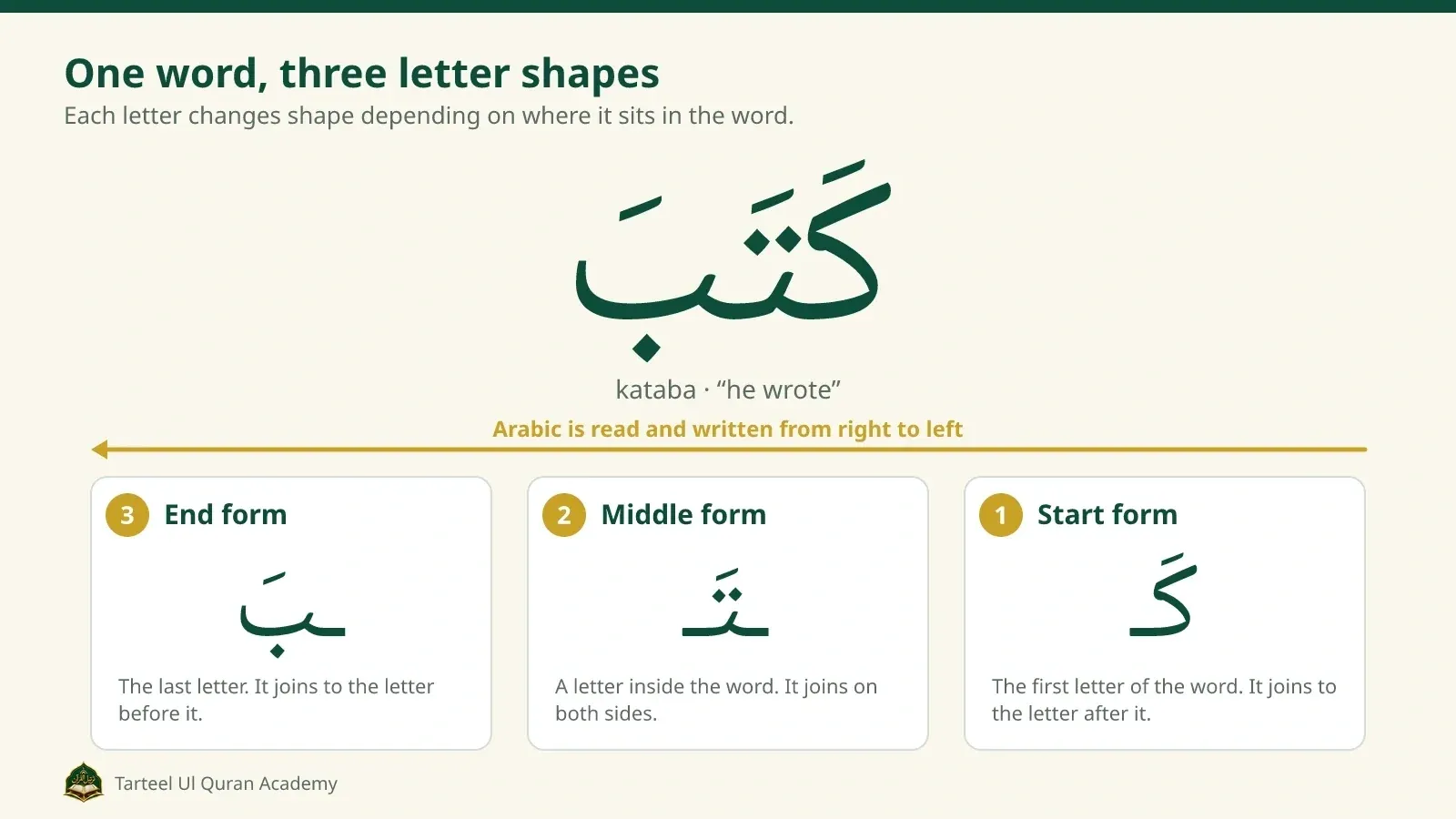
Two facts make joining easier. First, six letters never join to the letter after them: ا د ذ ر ز و. A gap after one of these is normal, not a new word. Second, a few letters, such as ه and ع, do change more than the others, so they deserve extra practice.
4. The dots are small details
Dots are what tell many Arabic letters apart, so they are never small details. Several letters share exactly the same base shape and differ only by the number and position of dots. Misreading one dot changes the letter, and a changed letter can change the word.
Arabic letter families that share a shape
| Shape family | Letters | What tells them apart |
|---|---|---|
| Boat shape | ب ت ث | ب one dot below, ت two dots above, ث three dots above |
| Hook shape | ج ح خ | ج a dot inside, ح no dot, خ a dot above |
| Small angle | د ذ | د no dot, ذ one dot above |
| Curved tail | ر ز | ر no dot, ز one dot above |
| Teeth shape | س ش | س no dots, ش three dots above |
| Loop shape | ص ض | ص no dot, ض one dot above |
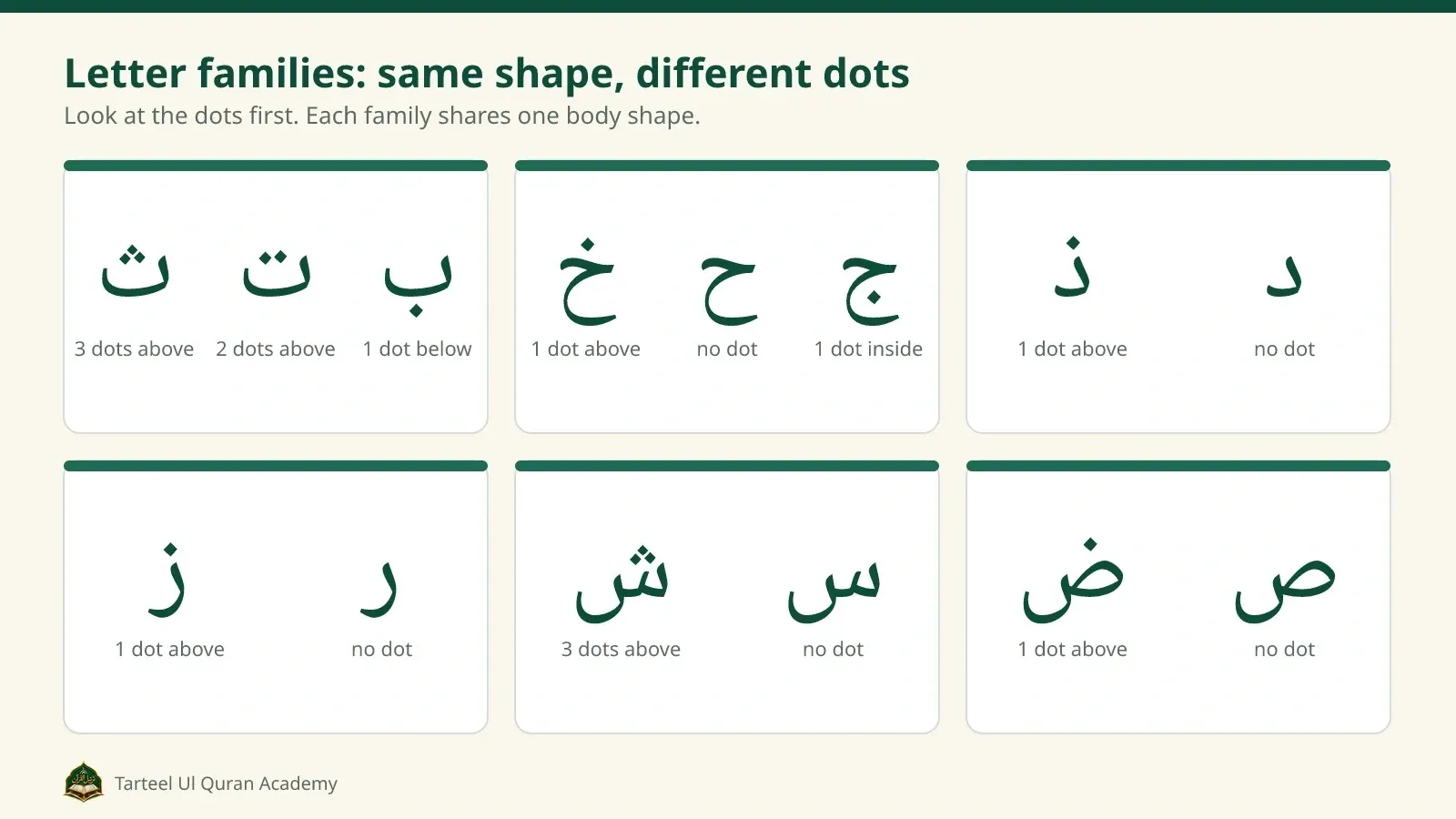
Learning letters in these families halves the work: you learn one shape, then the dots. The Quran Reading Basics flashcards use the same idea.
5. Harakat are optional extras
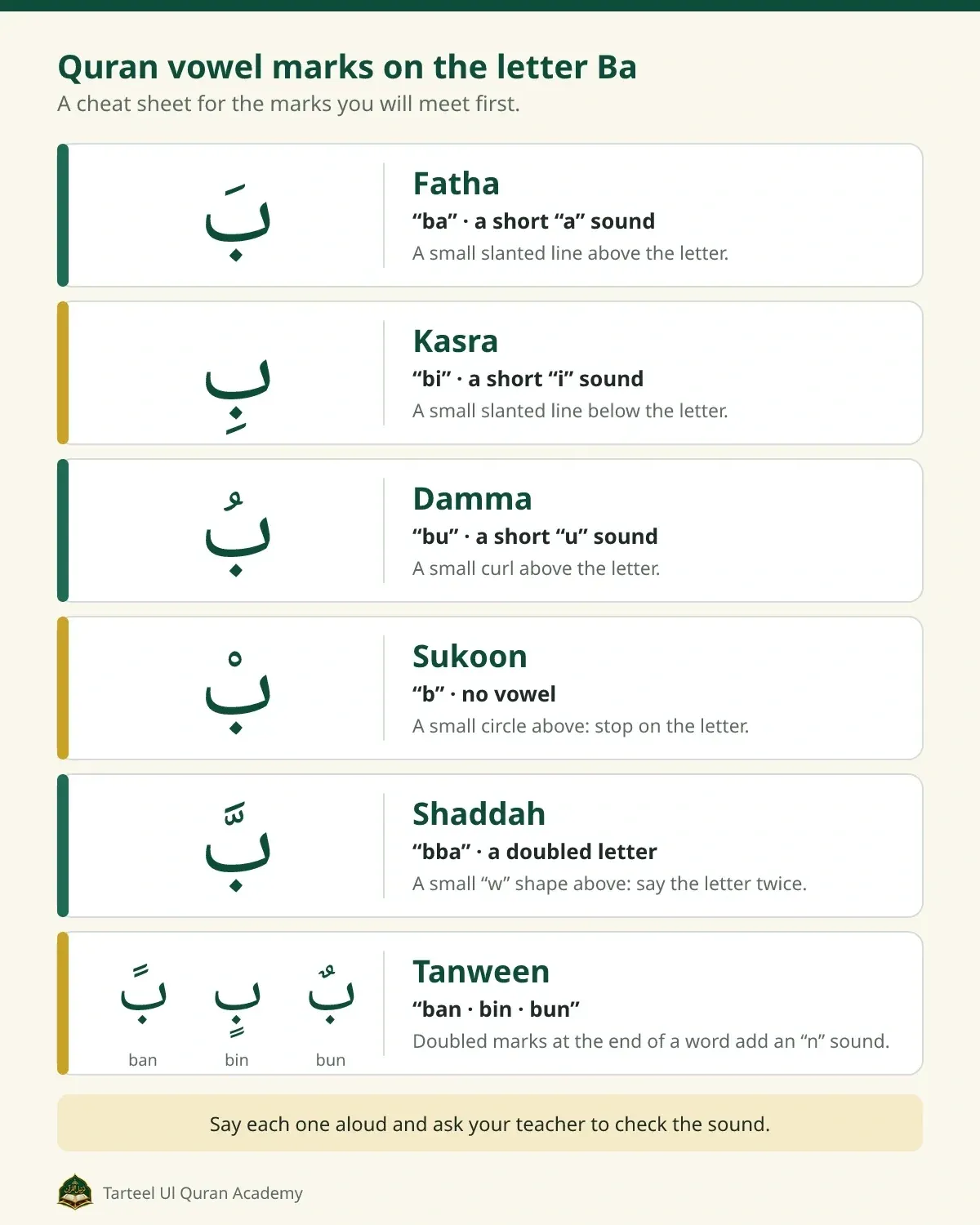
Harakat are the short vowel marks that tell you which sound follows each letter, and in the Mushaf they are part of the text, not decoration. Fatha above a letter gives an a sound, kasra below gives an i sound and damma above gives a u sound. Without the mark, you would be guessing.
On the letter ب, that gives بَ (ba), بِ (bi) and بُ (bu). Read them aloud a few times and notice that only the mark changed. The names come from long tradition and also appear in the Unicode Arabic chart that every font follows. Our Quran glossary lists every mark with a short explanation.
6. Sukoon means stop and shaddah means say it louder
Sukoon and shaddah are often misread as instructions about pausing or volume, but both describe how a letter joins its neighbours. Sukoon means the letter has no vowel of its own and closes the syllable before it. Shaddah means the letter is doubled: read once with sukoon and once with its vowel.
In مِنْ (min), the sukoon on ن means you say min, not mina. In رَبِّ (rabbi), the shaddah on ب means you say rab-bi, holding the b across both syllables. Neither one is a pause, and neither is louder.
7. Reading faster means you are improving
Reading faster is not the same as reading better, and rushing usually slows progress. Speed that comes before accuracy turns small mistakes into habits, and habits take longer to fix than letters take to learn. Steady, correct reading is the goal; natural speed follows on its own. The Quran itself asks for measured recitation: "recite the Quran in a measured way" (Quran 73:4, The Clear Quran translation).
A good test is to read a short line slowly and correctly three times, then a little quicker once. If the quicker read breaks, go back to slow. A Qaida page that has been nearly finished for three weeks is not a failure. It is a page doing its job.
8. The Noorani Qaida is only for children
The Noorani Qaida is a step-by-step primer for anyone starting from the letters, and adults use it as often as children. It moves from single letters to joined forms, vowel marks, sukoon, shaddah and real Quranic words, which is the same path any beginner needs. Adults simply move through some stages faster.
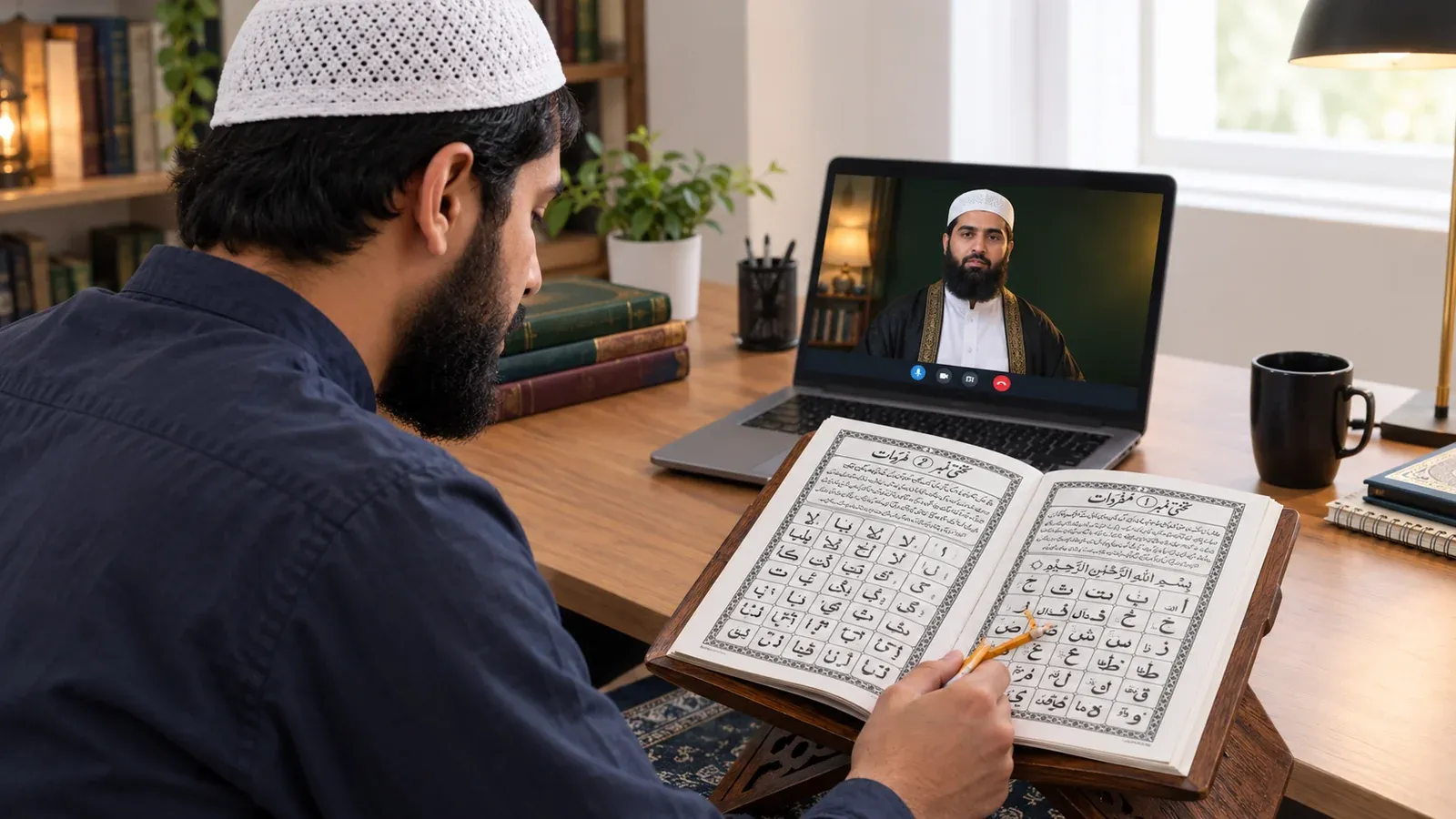
The Prophet ﷺ said that the one who recites the Quran with difficulty has a double reward (Sahih Muslim 798). Struggling at the start is part of learning, at any age. Our guide to learning the Quran as an adult deals with the embarrassment many adults feel.
How long do Quran reading foundations take?
Quran reading foundations usually take a few months with regular lessons and short daily practice, though every learner is different. In our reading course, letters and sounds often take three to six weeks, joining letters two to four weeks, and the vowel mark stages a few weeks each before reading from the Mushaf.
Typical timings in our Quran Reading course (a guide, not a deadline)
| Stage | What it covers | Typical time |
|---|---|---|
| Letters and sounds | The 28 letters, makharij, letters easily confused | 3 to 6 weeks |
| Joining letters | Start, middle and end shapes; spotting letters in words | 2 to 4 weeks |
| Short vowels and sukoon | Fatha, kasra, damma; closing syllables | 3 to 5 weeks |
| Tanween, shaddah, long vowels | Double marks, doubled letters, madd letters | 3 to 5 weeks |
| From the Qaida to the Mushaf | Short surahs, stopping and starting, early Tajweed | 2 to 4 months |
Treat these ranges as encouragement. The Prophet ﷺ said the most beloved deeds are the most regular, even if small (Sahih al-Bukhari 6464). Ten minutes a day usually beats one long session a week.
What should you do if one of these sounds like you?
If one of these misunderstandings sounds familiar, the fix is usually small: go back one stage, practise that stage aloud for a few days, and ask your teacher to listen. Nobody needs to start again from zero because of one myth.
- Myths 1 and 8 sound like you: start with the letters, at your own pace, in private lessons.
- Myths 2 and 3: relearn the sounds and the core shapes, family by family.
- Myths 4 to 6: slow down on dots and marks with a cheat sheet beside you.
- Myth 7: read slowly and correctly three times before speeding up.
Frequently asked questions
Can I learn to read the Quran without a teacher?
You can learn the letter shapes from books and apps, but correct pronunciation needs someone who can hear you. Many sounds in Arabic do not exist in English, and you cannot easily hear your own mistakes. A teacher who listens and corrects early saves months of unlearning later.
How many letters are in the Arabic alphabet?
The Arabic alphabet has 28 letters. Many of them share a base shape and are told apart by dots, so learning them in families, such as ب ت ث or ج ح خ, makes them faster to recognise. The Noorani Qaida introduces them in a careful order.
What is the difference between harakat and tanween?
Harakat are the single short vowel marks: fatha, kasra and damma. Tanween is a doubled form of those marks at the end of a word, which adds an n sound, as in بً (ban), بٍ (bin) and بٌ (bun). Both appear throughout the Mushaf.
Is it too late to learn Quran reading foundations as an adult?
No. Adults learn to read the Quran from the letters every year, and many move faster than they expect because they understand the logic of the marks. Private lessons help with embarrassment, and short daily practice fits around work and family.
Which Quran reading foundations should children learn first?
Children usually start with the letters and their sounds, a few at a time, then joined forms and short vowels. Short, regular lessons work best for young learners, with a few minutes of practice at home between lessons.
What is a sensible next step with Quran reading foundations?
The most sensible next step with Quran reading foundations is to find out exactly which stage you are at, then practise that stage aloud for a few minutes each day. A short reading check with a teacher answers the first question in one lesson.
- Read the letters ب ت ث ج ح خ aloud and note any you are unsure of.
- Check where to start with our placement guide.
- Book a free trial lesson so a teacher can hear you read.
When you are ready to build a routine, our guides on practising without feeling overwhelmed and a realistic first-month plan pick up from here.
Religious and linguistic details in this guide follow the academy's teaching sequence (Hafs an Asim) and are reviewed by the academy's teacher. For rulings, consult a qualified scholar.