
A Realistic First-Month Quran Reading Plan for Beginners
Two realistic four-week Quran reading plans, one for complete beginners and one for returners, with weekly goals, review points and what to do if a week takes longer.

Muhammad AreebUpdated · 10 min read
The short version
- Most complete beginners spend month one on letters and the start of joining.
- Returners who know their letters can cover harakat, sukoon and shaddah in month one.
- End each week with a review point before moving on.
- If a week runs long, repeat it; that is part of the plan.
A realistic Quran reading plan for the first month sets one stage per week and a short review point at the end of each. Complete beginners usually spend the month on the Arabic letters and the first joined forms. Learners who already know their letters can use the month for harakat and short vowels, then sukoon and shaddah.
Plans that promise the whole Qaida in thirty days are like gym posters promising abs by Friday: motivating for a morning, discouraging by Tuesday. Most beginners do better with a plan that admits how learning actually goes, with room for a slow week and a clear signal for when to move on.
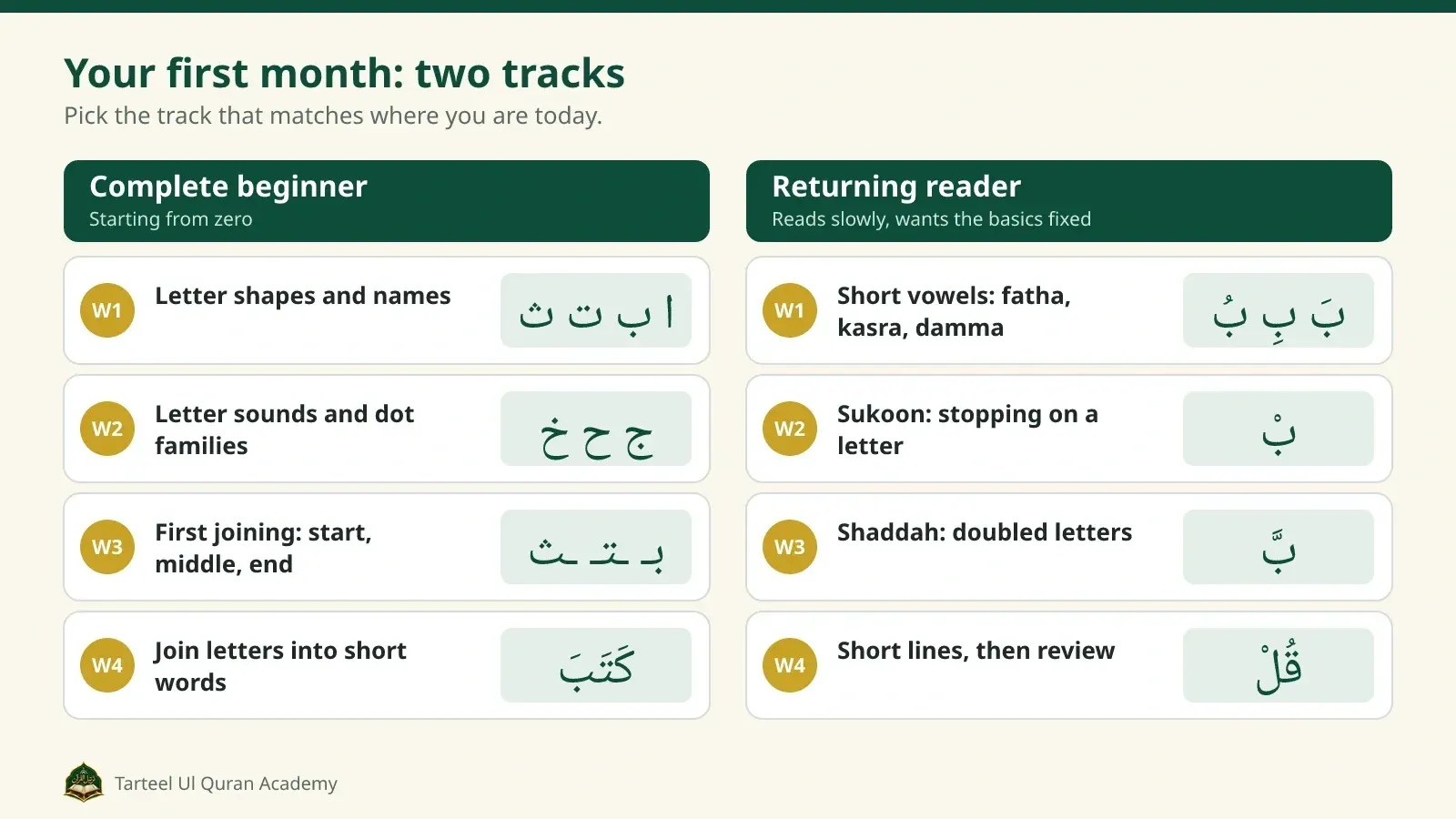
This guide gives two realistic four-week Quran reading plans for getting started readers. Track A is for complete beginners starting from the Arabic letters. Track B is for returners who recognise the letters and need the vowel marks. Both use the stage timings from our Quran Reading course, and both end each week with a review point.
What can a beginner realistically learn in the first month?
In the first month, a complete beginner can realistically learn the 28 Arabic letters with their sounds and start reading simple joined forms. A returner who already recognises the letters can usually work through harakat and short vowels and begin sukoon and shaddah. Both assume two or three lessons a week and about 10 minutes of daily practice.
Those estimates come from how our reading course runs. Letters and their sounds often take three to six weeks, joining letters two to four weeks, and short vowels with sukoon three to five weeks. So a single month covers one or two stages, not the whole Qaida. That is a normal pace for Quran reading for beginners, not a slow one.
Which first-month track fits you?
| If this sounds like you | Use | Month one covers |
|---|---|---|
| I cannot read the Arabic letters yet | Track A | Letters, sounds, letter families, first joined forms |
| I learned as a child but forgot most of it | Track A, faster | A quick letter refresh, then joining |
| I know the letters but stumble on the marks | Track B | Joined forms, harakat, sukoon, shaddah, tanween preview |
| I read but slowly, guessing a lot | Neither: guided reading | Reading practice with a teacher from the Mushaf |
Not sure which row is yours? The placement guide helps you choose, and a trial lesson settles it in a few minutes.
How should you set goals for the first month?
In any Quran reading plan for beginners, set first-month goals around a habit and a stage, not a page count. A good goal sounds like this: three lessons a week, ten minutes of practice on the other days, and the letter families read aloud without hesitation by the end of week two. Goals like that are clear enough to check and flexible enough to survive a busy week.
- Lessons: two or three a week suits most beginners; five a week moves faster if you can keep it up.
- Practice: about 10 minutes on non-lesson days, at the same time each day.
- Stage goal: one stage per week, written with your teacher.
- Review point: a short check at the end of each week before moving on.
You can compare lesson frequencies on our pricing page and plan times across time zones with the lesson scheduling guide. The Prophet ﷺ said the most beloved deeds are the most regular, even if small (Sahih al-Bukhari 6464).
Track A: a first-month plan starting from zero
Track A spends three weeks on the letters and their sounds and the fourth on the first joined forms. The order follows the Noorani Qaida: single letters first, then the shapes they take when they join. Each week ends with a review point, and any week can be repeated.
- Week 1: the first group of letters and their sounds
- Week 2: the rest of the letters, learned in families
- Week 3: letters easily confused and heavy letters
- Week 4: first joined forms and a full review
Week 1: the first group of letters and their sounds
Week 1 introduces the first group of letters, roughly from ا to ز, with the exact sound of each. Read every letter aloud, slowly, and let your teacher correct the sound straight away. Slow and measured is the point; the Quran itself asks for recitation "in a measured way" (Quran 73:4). Review point: you can name and sound each letter in the group when your teacher points to it in a random order.
Week 2: the rest of the letters, learned in families
Week 2 completes the alphabet, from س to ي, and groups letters into families that share a shape, such as ب ت ث or س ش. Learning the shape once and the dots separately makes the second half quicker than the first. Review point: you can read all 28 letters in order and in a mixed row.
Week 3: letters easily confused and heavy letters
Week 3 slows down on the letters beginners most often confuse, and on the heavy letters that are said with a fuller sound. Common pairs are ح and ه, س and ص, ت and ط, and ك and ق. Week 3 is when ح and ه finally stop being twins and start being cousins.
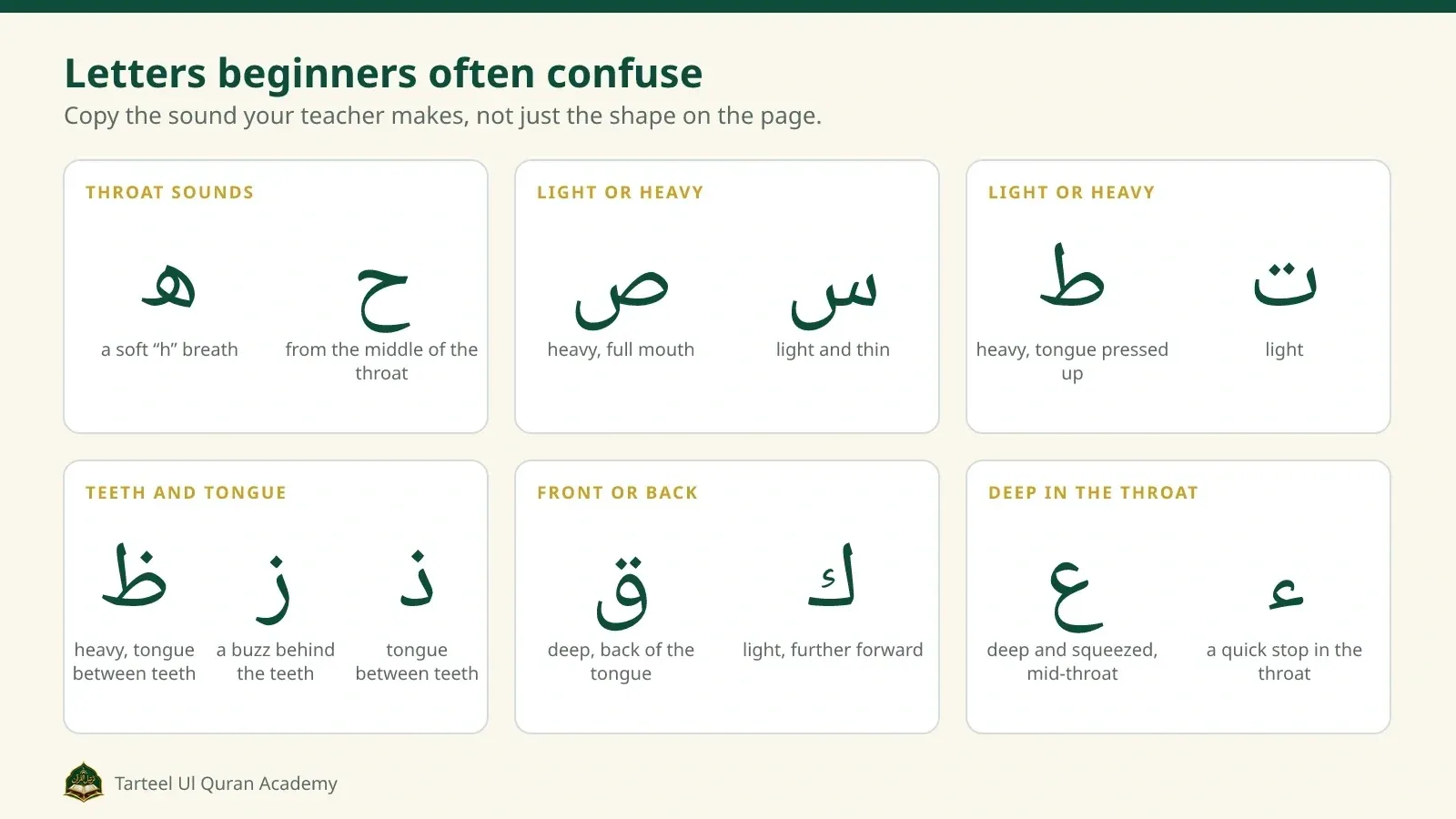
The makharij guide shows where each of these sounds comes from. Review point: your teacher hears each pair clearly different, three times in a row.
Week 4: first joined forms and a full review
Week 4 starts reading letters joined together, beginning with two-letter combinations, and ends with a review of the whole month. Notice which letters do not join to the next one (ا د ذ ر ز و), because those gaps are normal. Review point: you can read a row of simple joined pairs without stopping on every letter.
Track B: a first-month plan for returners
Track B is for learners who already recognise the letters. It spends the month on the marks that turn letters into syllables: harakat and short vowels in week 2, sukoon in week 3, and shaddah with a preview of tanween in week 4. Week 1 refreshes joined forms so the marks have something solid to sit on.
Track B week by week
| Week | Focus | Example | Review point |
|---|---|---|---|
| 1 | Joined forms refresh | كَتَبَ read as three joined letters | Read joined pairs and triples without pausing |
| 2 | Harakat and short vowels | بَ بِ بُ, then on joined letters | Read a row of mixed marks correctly |
| 3 | Sukoon | قُلْ (qul), مِنْ (min) | Close each syllable without adding a vowel |
| 4 | Shaddah and tanween preview | رَبِّ (rab-bi), بً بٍ بٌ | Hold doubled letters across both syllables |
Weeks 2 and 3: harakat, short vowels and sukoon
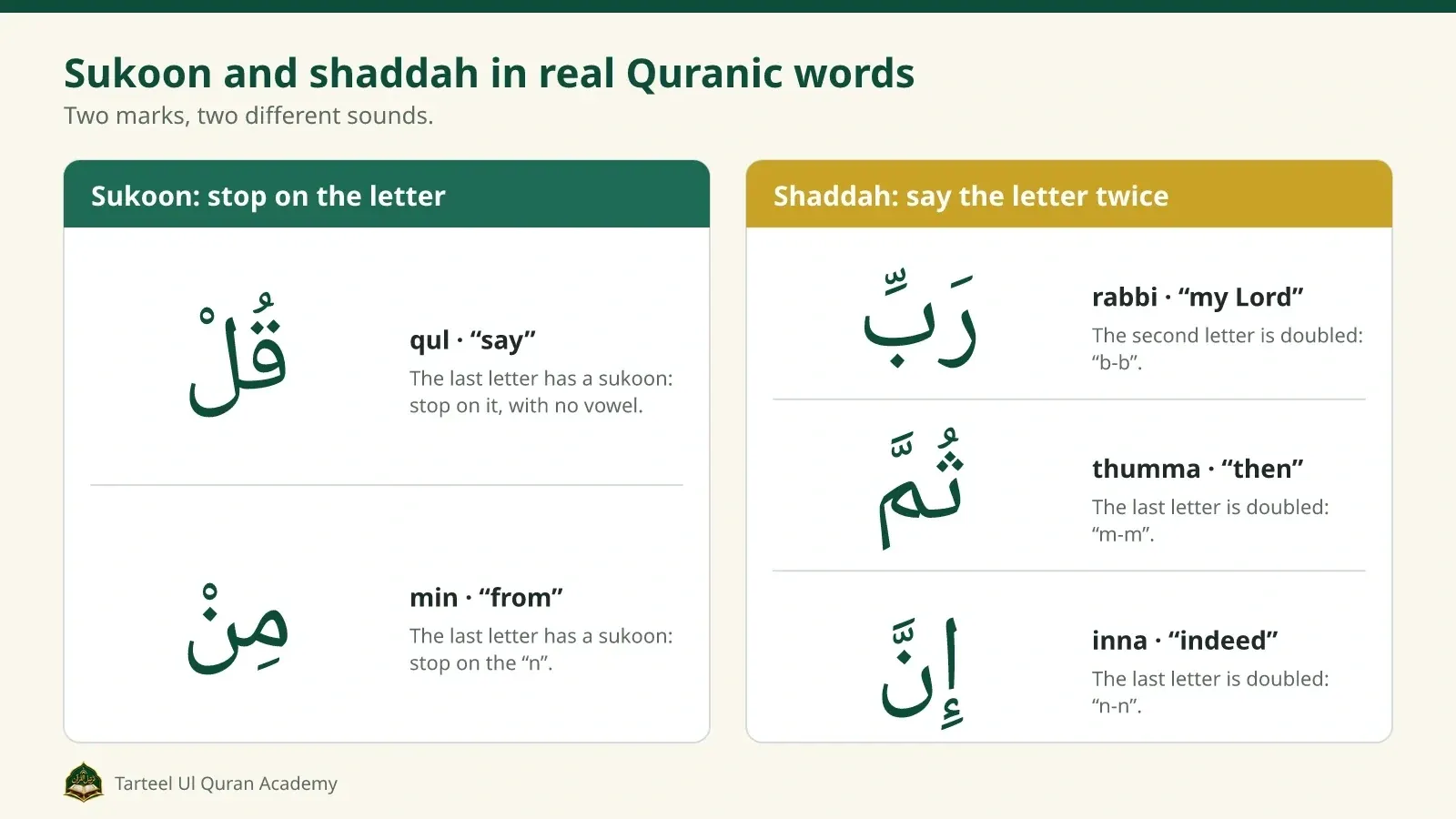
Harakat are the short vowel marks: fatha gives an a sound, kasra an i sound and damma a u sound. Sukoon marks a letter with no vowel, which closes the syllable before it. In قُلْ you say qul, and in مِنْ you say min, with no extra vowel at the end. The mark names follow the Unicode Arabic chart, so you will see them the same way in every app.
Week 4: shaddah and a first look at tanween
Shaddah doubles a letter: you read it once closed and once with its vowel. In رَبِّ you say rab-bi, in ثُمَّ thum-ma, and in إِنَّ in-na. Tanween, the doubled vowel mark at the end of a word, adds an n sound: بً ban, بٍ bin, بٌ bun. Our Quran glossary defines each mark.
How do you run a weekly review point?
A weekly review point is a five-minute check at the end of each week that decides whether to move on or repeat. Read the week's material aloud to your teacher, in a mixed order, without preparing first. If you read it steadily and the sounds are right, move on. If not, repeat the week with the same target.
- Read the week's letters or marks in a random order, not the order you practised.
- Count only clear, correct sounds; hesitation is fine, guessing is not.
- Ask the teacher which one or two items to carry into next week.
- Write the result in your planner before the next lesson.
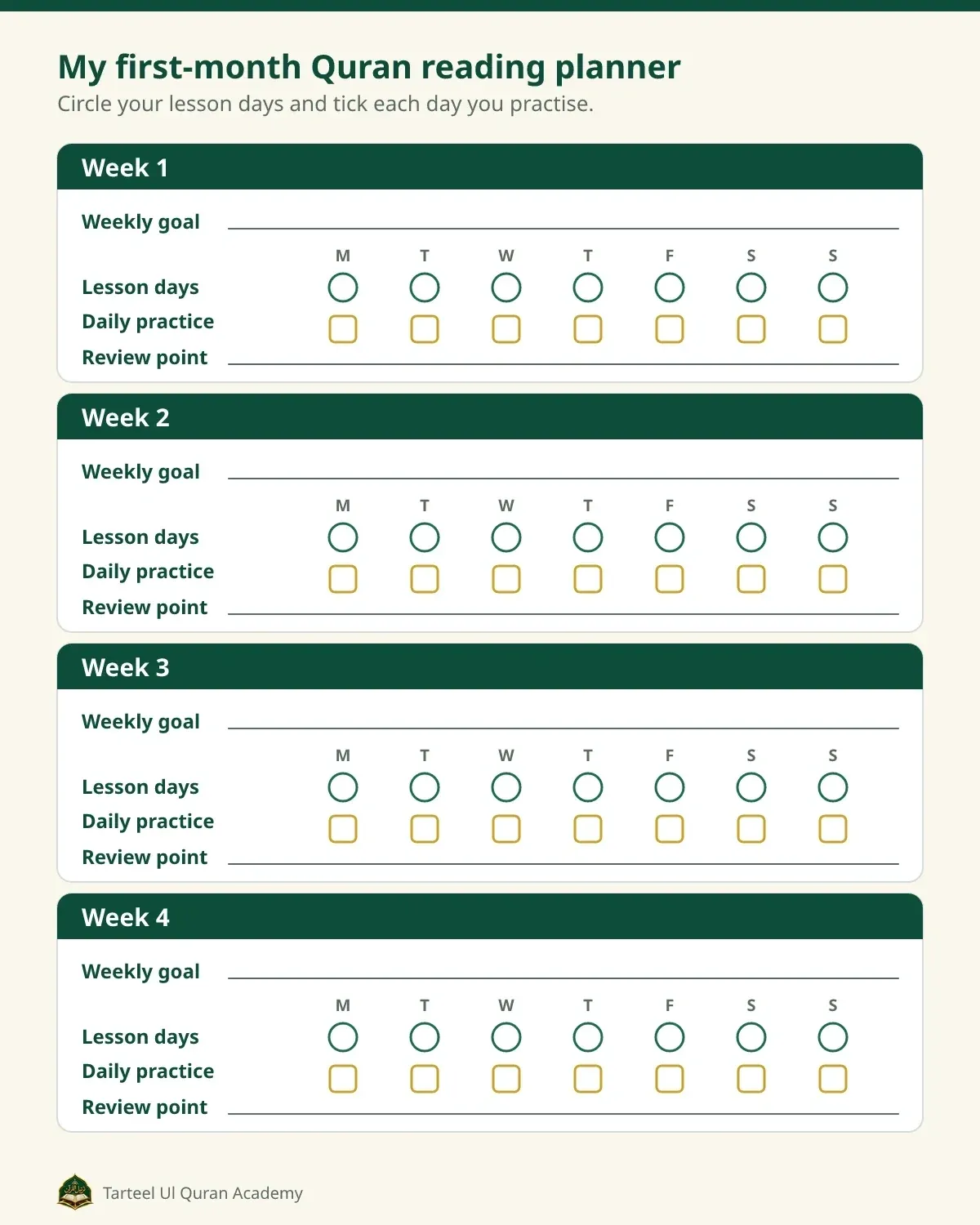
If you want to see how this kind of feedback is shared after lessons, the page on how student progress is reviewed explains it.
What should you do if you fall behind the plan?
If you fall behind your Quran reading plan, repeat the current week instead of skipping ahead, and shrink the daily target until practice feels steady again. Falling behind usually means the target was too big or practice was irregular, not that the learner cannot do it. If week two takes three weeks, the plan has not failed. It has met a real person.
What to change when a week runs long
| What happened | Change this | Keep this |
|---|---|---|
| Missed several practice days | Restart with the last solid line | Same lesson days |
| Review point failed on two or three items | Repeat the week with only those items | The rest of the week's material as warm-up |
| Letters keep getting mixed up | Practise in families and confusable pairs | Reading aloud every day |
| Practice feels like a chore | Shorter sessions that end on a success | The same time each day |
The Prophet ﷺ promised a double reward to the one who recites with difficulty (Sahih Muslim 798). A slower month is still a rewarded month. For a calm daily routine, see how to practise without feeling overwhelmed.
Frequently asked questions
Can you finish the Noorani Qaida in one month?
Most beginners cannot, and they do not need to. In our reading course, letters alone often take three to six weeks and the full Qaida usually takes a few months. A good first month builds one or two solid stages, which makes the later stages much faster.
How many lessons a week should a beginner take in the first month?
Two or three lessons a week suits most beginners, with about 10 minutes of practice on the other days. Five lessons a week moves faster and suits learners with more time. Consistency matters more than the number.
Should a beginner learn Tajweed in the first month?
Correct pronunciation of each letter, which is part of Tajweed, starts from the first lesson. The named Tajweed rules usually come after the Qaida stages, once reading is steady. Our guide to what Tajweed is explains the rules that follow.
When should a beginner learn sukoon and shaddah?
After the letters, joined forms and short vowels feel steady. For a complete beginner that is usually after the first month; for a returner who already knows the letters, it can be weeks three and four. Your teacher's review points decide the timing.
Does this plan work for children?
Yes, with shorter sessions and smaller weekly targets for young children. The order of stages is the same. Many children take longer per stage than adults, which is normal and expected.
What is the sensible next step after the first month?
After the first month, the sensible next step is to continue the Quran reading plan one stage at a time: joining for Track A learners, tanween and long vowels for Track B. Keep the same lesson days and the weekly review point, and let your teacher set the next four goals.
- Write next month's four weekly goals with your teacher.
- Keep 10 minutes of daily practice on non-lesson days.
- Read our Noorani Qaida guide to see the stages ahead.
If you have not started yet, a trial lesson tells you which track to follow, and our guide to Quran reading foundations clears up the most common worries first.
Religious and linguistic details in this guide follow the academy's teaching sequence (Hafs an Asim) and are reviewed by the academy's teacher. For rulings, consult a qualified scholar.